Author Archives: sln

N.K.A.W.T.G – Nobody Kicks Ass Without Tanker Gas

Air-to-air refueling


Find out what’s behind the cryptic title and come on a visit to the 100th Air Refuelling Wing at RAF Mildenhall.
BY: SØREN AUGUSTESEN
N.K.A.W.T.G – Nobody Kicks Ass Without Tanker Gas
The mysterious headline of this article needs no Latin translation skills as it is the unofficial tanker pilot motto: Nobody Kicks Ass Without Tanker Gas. In this article, we will take a look at the history of air refuelling, a closer look at the dominant tanker aircraft of the USAF and we will take to the skies on an air refuelling mission with the 351st Air Refuelling Squadron which is part of the 100th Air Refuelling Wing at RAF Mildenhall, England.

The history of air-to-air refuelling
The first attempts to refuel one aircraft in the air from another took place back in the early 1920s. The first successful air refuelling was finally conducted on 27 June 1923, between two Airco DH-4B bi-planes from the US Army Air Service. The refuelling was carried out by lowering a hose from the top aircraft to the receiving aircraft which was flying below and behind. One of the crew members on the receiving aircraft had to catch the hose and then manually insert it into the normal filling point.

Just one month later three DH-4B aircraft, two tankers and one receiver aircraft, set a world record by keeping the receiver aircraft in the air for over thirty seven hours. This was made possible by nine air refuelling’s during which 2600L of fuel and 140L of engine oil were transferred.

During the 1920s and ‘30s, the techniques and the equipment used for air refuelling were refined and in 1935, the record for the longest time in the air had been raised to twenty seven days. Air refuelling was still a complex and dangerous task and it was not until the late 1930s that Richard Atcherley from the RAF developed the first practical air-refuelling system called the “looped-hose”.

Even with a more convenient and safe method to perform air-refuelling, it was still seen as something that was most useful for long-haul commercial aircraft. It was only during the very last months of WWII that the USAAF began to consider using air-refuelling to extend the range of their bombers during the expected battle for the Japanese mainland. However, the war ended before these plans could be implemented.

After the war, the USAF rebuilt a small number of B-29 Superfortress aircraft so they could act as air-refuelling aircraft and refuel other B-29’s and the later B-50 bombers.

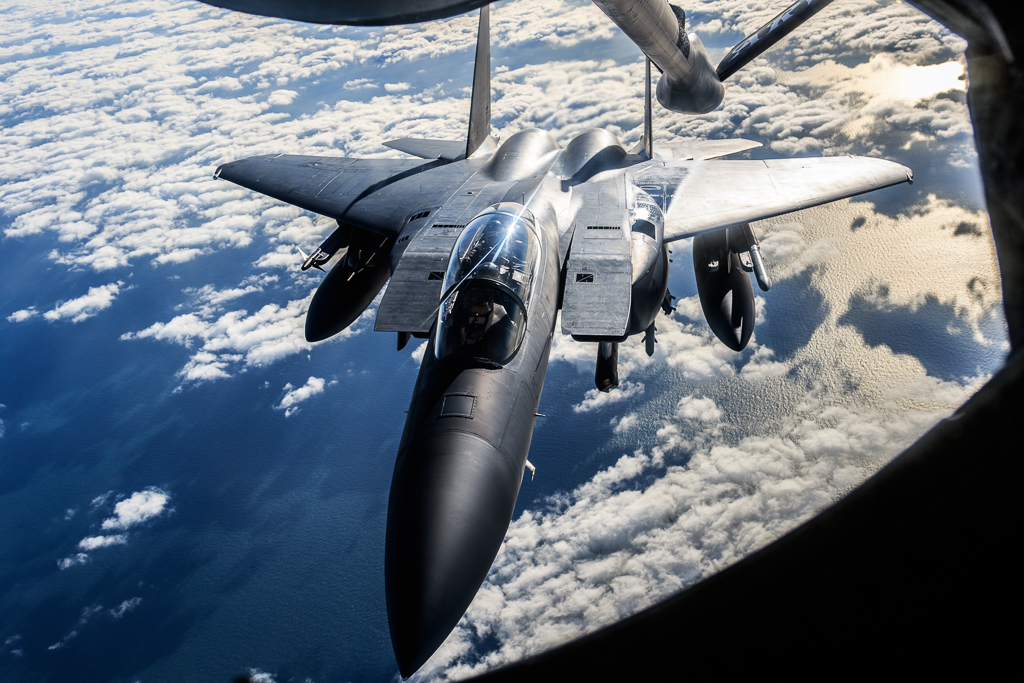
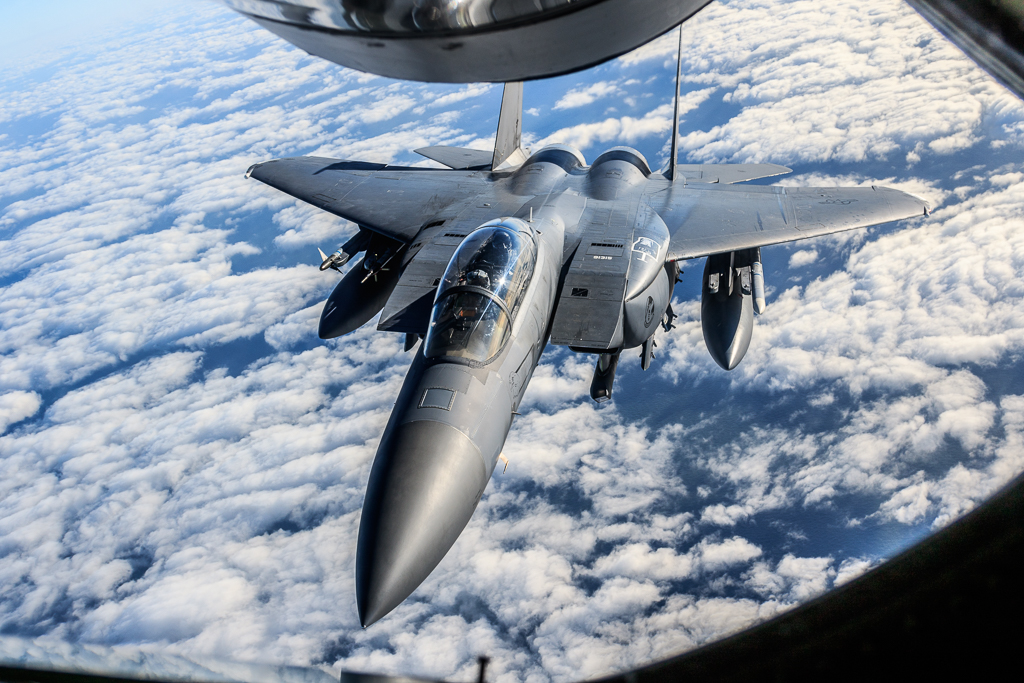
A F-15E Strike Eagle is being refueled while both the KC-135 and the F-15E carries out a soft and steady left turn.

“The advantages of the probe-and-drogue system are that it is relatively simple and can be retrofitted to many different types of aircraft”
An example of the “probe-and-drogue” tanking method. A USMC KC-130 tanker aircraft, is “tanking” two CH-53 Super Stallion helicopters.
Probe-and-Drogue
After WWII, the company behind the looped-hose method, Flight Refuelling Ltd, realised that this system was not an optimal way to conduct air-to-air fuelling so they began developing a newer and better idea. What they came up with was the “probe-and-drogue” system, which is one of the two methods still used today for air-to-air refuelling.

A probe-and-drogue system was installed in a Lancaster from the RAF and to test the system, a modified Gloster Meteor F.3 was used for the refuelling trials. In short, the probe-and-drogue system works by the tanker aircraft unreeling a fuel hose out into the slipstream behind itself. At the end of the hose is a basket shaped like a badminton shuttlecock. The receiver aircraft must connect to the inside of the basket using an external probe that is connected to the aircraft fuel tanks.

Some of the advantages of the probe-and-drogue system are that it is relatively simple and can be retrofitted to many different types of aircraft, from large transport aircraft such as the C-130 Hercules to smaller fighter aircraft like the F/A-18 Hornet. On larger aircraft, multiple probe-and-drogue systems can be installed, for instance one under each wing making it possible to refuel two aircraft at the same time.

However, there are also some drawbacks to the design including a slow fuel flow (between 680 to 2040 kg per minute). This is due to the relatively small diameter fuel hose which in turn means it takes longer to refuel the receiving aircraft. It can also be difficult for the receiving plane to insert the probe into the basket due to turbulence behind the tanker aircraft.

Today, most US Navy aircraft and helicopters as well as some of the USAF and US Army’s helicopters use the probe-and-drogue method. In addition, all non-US aircraft manufacturers use the probe-and-drogue system in their designs if in-flight refuelling is needed.res jagerfly.


Flying boom
In the late 1940s, Boeing was given the task of developing a system that was able to transfer fuel faster than the probe-and-drogue method. This resulted in the “flying boom” system. The rigid, larger diameter fuel pipe, or boom, is guided into a mating receptacle on the receiving aircraft by the operator, called the “boomer”, on board the tanker aircraft.

The system was first installed on a B-29 aircraft in 1950 and a total of 116 B-29s were converted to KB-29P models by Boeing. Subsequently, Boeing developed the KC-97 tanker aircraft. However, as the KC-97 had both propeller engines and jet engines, it meant that it had to carry two types of fuel, which proved to be less than ideal. Despite this, the flying boom concept had proven its worth as it offered a number of advantages over probe-and-drogue method amongst which were a much high fuel flow rate (up to 2900 kg per minute).

Having the boom controlled by the boomer on board the tanker also made it easier to refuel in bad weather. Planes with a flying boom installed, could typically also be retrofitted with probe-and-drogue system under their wings to overcome the main disadvantages of the flying boom, that is to say that it can only refuel one aircraft at a time.

After building the KC-97, Boeing received orders from the USAF to develop a new tanker aircraft based on their 367-80 (Dash-80) concept. This resulted in the KC-135 Stratotanker.The flying boom system is now standard on all USAF fixed wing aircraft that need aerial refuelling.

The mighty flying gas station, KC-135 is ready for the next sortie.
The WSO on this F-15E Strike Eagle keeps a sharp eye on the boom while the pilot keeps the plane in the correct formation with the tanker aircraft.

Boeing KC-135 Stratotanker
The first KC-135A tanker aircraft were delivered to the USAF on 24 January 1957. A total of 808 C-135 aircraft were delivered to the USAF, in various models and configurations:
  • 729 KC-135A – Standard tanker configuration
  • 17 KC-135B – Temporary designation for EC-135 type
  • 18 C-135A – Standard transport aircraft
  • 30 C-135B – Standard transport aircraft
  • 4 RC-135A – Special edition used for mapping
  • 10 RC-135B – Temporary designation for special surveillance

All aircraft were delivered with either the Pratt & Whitney J57-P-59W turbojet engines (A models) or the Pratt & Whitney TF-33-PW-102 turbofan engines (B models). Of the total of 808 aircraft delivered to the USAF, approximately 454 are still in use today. These aircraft have undergone many updates over the years and they have evolved to cope with many tasks other than just air refuelling.

The turbojet engines used in the A-models were very inefficient as they had high fuel consumption and required long runways for take-off. As a temporary solution, the USAF began to replace turbojet engines with TF-33-PW-102 turbofan engines in 1982. These engines were taken from retired airliners and in total, over 150 KC-135A models had their engines replaced. Their designations were changed to KC-135E.

The latest upgrades
As the first E-models were put into service by the USAF, Boeing came up with a proposal for a more radical plan to extend the service life of the KC-135 family. One of the major changes was to install the high-bypass turbofan CFM International CFM56 engines. These received the military designation F-108-CF-100.

This engine gave significant improvements in terms of both more power and lower fuel consumption. Boeing completed the first upgrade with this type of engine in June 1984 and this aircraft model was designated the KC-135R. Besides the new engines, the upgrade also included an auxiliary power unit (APU), which is located in the rear of the aircraft’s cargo compartment. The APU meant that the aircraft was now able to start the engines without help from equipment on the ground.

R-models were also given the so-called Pacer CRAG update, which replaced the old analogue style cockpit with a new digital version. These and a number of other upgrades, transformed KC-135 aircraft into the modern planes that will be in service for many years to come.

Today’s KC-135 models
There are five types of KC-135 tanker aircraft currently in the USAF inventory:
  • KKC-135R: Standard tankers, a total of 313 in service
  • KC-135T: Originally KC-135Q used to refuel SR-71 Blackbirds, a total of 54 in service
  • KC-135R AAR: KC-135R tanker aircraft which can receive air refuelling via a receptacle above the cockpit, a total of 8 in service
  • KC-135R MPR: KC-135R with probe-and-drogue refuelling system under the wings, a total of 20 in service

A total of 22 KC-135R tanker aircraft are upgraded to perform tasks with US Special Forces, but the detail of the upgrades is classified.
“The upgrade also included an auxiliary power unit (APU), which is located in the rear of the aircraft’s cargo compartment. The APU meant that the aircraft was now able to start the engines without help from equipment on the ground”
After the start of the four engines, the KC-135R aircraft taxis
out to RAF Mildenhall runway 11.

As if it’s not hard enough to get a large aircraft in close formation with the tanker aircraft,
it must be done while both aircrafts are flying in an oval track.
Tanker for strategic bombers
Initially the plan was to primarily use the KC-135’s to refuel Strategic Air Command’s (SAC) B-52 bombers and as such the KC-135 units were often placed on SAC bases with B-52 aircraft. However during the Vietnam War, the KC-135 aircraft were heavily involved in refuelling fighters, attack aircraft and bombers during the attacks on North Vietnam. Since then, air refuelling has become an integral part of virtually all combat missions flown.

Nowadays with the global war on terror which the US began after the attacks on September 11 2001, the KC-135 units have been very busy. The many fighter jets, transport planes and bombers participating in operations over Afghanistan and Iraq rotate regularly with new units from bases in the United States and they all require air fuelling on the trips back and forth. In addition to this, many combat missions also require air fuelling.

KC-135 outside USAF
Despite the KC-135 aircraft’s success as tanker aircraft in the USAF, only France has bought brand new KC-135 aircraft. Between 1963 and 1964, the French Air Force received twelve KC-135F Stratotanker aircraft.

They were primarily used to refuel the Mirage IV aircraft. One of planes crashed in 1972 and the remainder have all been upgraded to KC-135R standard now.

Between 1997 and 1998, Turkey purchased seven ex-USAF KC-135A aircraft, all of which were upgraded to KC-135R standard. Singapore Air Force bought four KC-135A aircraft in 1998 and these were all upgraded to KC-135R MPR standard. The only KC-135E models to have been exported, three examples, were sold to Chile in 2008, where they replaced old Boeing 707’s.

Five KC-135 aircraft are currently in AMARG in Arizona where they are ready to be sold to an as yet un-named buyer. In April 2013, the United States approved the sale of a unpublished number of KC-135 tanker aircraft to Israel as part of a major arms deal. Israel today uses eight old Boeing 707 aircraft and it is these that KC-135s will replace.

Although the exact numbers of aircraft is not known, it is expected that it will be the five KC-135 aircraft currently located on AMARG. These aircraft will require a major upgrade before delivery.

The future of the KC-135 Stratotanker
The replacement for the KC-135 aircraft is to be the Boeing KC-46, which, after “extra time and a penalty shoot-out” with the Airbus A330, was declared the winner of the USAF’s KC-X competition. The cost of producing the 179 aircraft that the USAF has ordered is so high that production will have to be spread out over many years.

Currently, the last example is not expected to be delivered until 2030. Logically, this means that there will still be KC-135 aircraft in service until then and by that time, the aircraft will have been in service for over seventy years.

351st ARS, 100th ARW – RAF Mildenhall
The KC-135 tanker aircraft have long been associated with RAF Mildenhall. The first unit on the base was Detachment 1, 98th Strategic Wing (SW), which in January 1970, moved from RAF Upper Heyford to RAF Mildenhall.

The unit’s primary task was to support RC-135 missions over Europe. For many years there were approximately sixteen KC-135’s temporarily stationed at RAF Mildenhall from units in the United States. Although the aircraft were dedicated to supporting the US Air Force Europe (USAFE), the aircraft were still under SAC command.

This was however changed on 1 February 1992, when the 100th Air Refuelling Wing (ARW) was activated at RAF Mildenhall, with fifteen KC-135R tankers attached to the 351st Air Refuelling Squadron (ARS). These tankers operate around the clock every day of the year.

The large reduction of USAF aircraft in Europe in the last few years has meant that the unit can concentrate more on refuelling the American transport, bomber and patrol aircraft flying to and from the US to combat zones, especially in the Middle East. In addition, the squadron is also responsible for a large part of the air refuelling training that many European air forces undertake as they do not have their own tankers.

The 351st ARS have a number of KC-135R MPR aircraft and can thus also train with air force’s using the probe-and-drogue method as well as the flying boom system, among them the Royal Danish Air Force, which regularly practice air refuelling with Mildenhall tankers.

At the beginning of 2015, the USAF announced that RAF Mildenhall was to be closed down. The MC-130H Hercules and CV-22B Osprey used by the 352nd Special Operations Group will move to the nearby RAF Lakenheath base while the 100th ARW and their KC-135R Stratotankers will most likely move to Ramstein in Germany.

The creew carries out the papers, and equipment they have had on the trip, after ending the mission, and KC-135 will then be handed over to ground personnel.
The pilots ensures that the KC-135 is in a constant soft left turn.

QUID 76
On February 6 2015, FLYMAG fortunate enough to fly on board a KC-135R from RAF Mildenhall – call sign QUID 76 – on an air refuelling mission.

BAt 06:00, the crew met to brief the mission. The briefing took place at a table in the squadron’s recreation area next to the pool table. Present were the pilot, co-pilot, two boomer’s and an instructor pilot. The briefing took place in a relaxed but professional atmosphere with the pilot starting by reviewing the day’s mission.

The original plan for the mission was to refuel six F-15E Strike Eagles from the nearby RAF Lakenheath base, but shortly before the briefing, the pilot was told that when the six F-15E had been refuelled, the remaining fuel should be given to an RC-135 Rivet Joint aircraft which was on its way back to the United States.

After briefly explaining who we were refuelling, the pilot went through the mission profile, which area we would be refuelling over, what bases were available in emergency situations, the weather and a myriad of other smaller details about the mission.

After this, the co-pilot went through the refuelling in more detail and finally the boomer reviewed the refuelling operations from his point of view.

Lastly, at the end of the briefing, the boomer covered the safety procedures for the passengers who were along for the flight (FLYMAG and two press officers). When the briefing was over, all the necessary equipment was loaded on board a bus that took us to the aircraft waiting in the morning darkness.

By the aircraft, we were met by the crew chief responsible for the aircraft. He and the pilot went over the things that have been updated since the aircraft’s last flight and once the plane had been handed over to the flight crew, we boarded the aircraft through a hatch on the left side, below the cockpit. Once inside the aircraft, the two pilots started to go through the many pre-flight checks, which needed to be completed before the engines could be started.

While the pilots were busy in the cockpit, one of boomers went over the safety procedures once again and also showed where the aircraft’s emergency exits were located and how to use them. As the sun slowly rose over England, the pilots got far enough into their pre-flight checks as to allow the APU inside the aircraft to be started.

Shortly after that, over the noise of the APU, a low “bang” was heard as the first engine started up. This was quickly followed by a further three as the remaining engines were started in sequence. With all four engines up and running, the APU was turned off again and the noise level inside the cargo compartment fell to a level which was comparable to that of a conventional passenger aircraft.

The first customers
At just past 08:00 local time, approximately one hour after we arrived at the aircraft, we were ready to taxi out to the runway. After getting permission from the tower, we taxied all the way out to runway 11. As soon as the aircraft was lined up on the runway and the tower had given take off clearance, the pilots applied full power to the engines and the plane accelerated swiftly down the runway. Once airborne, the pilot’s headed towards a refuelling area called “Track 8” over the North Sea.

This was where we were to refuel the F-15E’s and the RC-135 Rivet Joint aircraft. The Boomer was now busy getting ready for the first F-15E to be refuelled and he had his own checklist to go through to make sure everything worked the way it should. The short flight from Mildenhall to the refuelling area was a clear benefit to both the tanker and the aircraft to be refuelled as it cut down on time and fuel wasted going to and from the refuelling track.

At about 09:20, the first two F-15E to be refuelled arrived at the tanker. Standard procedure when refuelling aircraft arriving in formation is that they approach the tanker from below on the tanker’s left side. Once they have visual contact with the tanker, they get in formation on the tanker’s left wing.

The lead aircraft then asks the boomer for permission to move in behind the tanker. When the boomer is ready to refuel, permission is given. The receiving aircraft then slowly moves into a position behind and slightly below the tanker. Lights on the underside of the tanker guide the pilot of the receiving aircraft into the correct position.

Once the receiving aircraft is in a stable position within the correct area behind the tanker, the boomer guides the boom to the receiving aircraft refuelling receptacle. On the F-15E, this is located on the wing root on the aircraft’s left side. When the boom is in the correct position the boomer extends the fuel pipe rearwards until it locks into the receiving receptacle with an audible “klonk”. The job of actually pumping the fuel and ensuring that tanker aircraft remains in balance is the co-pilots task.

Since this was a training mission and it was not necessary to give the F-15E’s a full load of gas, the aircraft were only connected to the tanker for approximately two minutes. The boomer then released the boom and the receiver aircraft dropped slightly down and back to create a little distance with the tanker aircraft.

It then slowly moved over to the tankers right hand side and took up formation on the right wing. Here the aircraft waited until the second aircraft in the formation had been refuelled. Once both had completed their task and were sitting behind the right wing, they were cleared to leave the tanker; the two F-15E gently climbed away from the tanker.

The Weapon System Officer (WSO) ensures that the boomer hits air-refuelinghole on the first try.

The big delivery
Less than ten minutes later the next F-15E arrived for refuelling. This time the aircraft arrived alone and made a direct approach from behind and below the tanker. The boom made it hard to see anything rearwards from the observers position beside the boomer and the dark grey fighter suddenly popped up out of nowhere.

It slowly slid into position behind the tanker and the boomer guided the boom safely into the receiver aircraft’s refuelling receptacle. Again, the two aircraft were only connected for a few minutes before the boomer broke contact and the F-15E fell back and turned right to disappear, continuing on its mission.

This was followed by another lone F-15E and finally two more Strike Eagles arriving in formation. We had now refuelled the six F-15E Strike Eagles that the initial briefing called for, but there were two more aircraft in the area and they asked for permission to come up and be refuelled. This was approved and they duly arrived in formation about five minutes later to receive their fuel.

Now we only needed to refuel the RC-135 Rivet Joint. The RC-135 is one of the many variants of the C-135 aircraft family that are in service with the USAF. The plane arrived at the tanker around fifteen minutes after the last two F-15E had departed, coming in from behind and well below. The RC-135 approached slowly whilst it climbed into the correct position behind the tanker.

The connection
After several minutes of careful manoeuvring the RC-135 aircraft was in close formation behind the KC-135R aircraft and the boomer guided the boom down into the refuelling receptacle located just above the cockpit.

The plan was to give the RC-135 aircraft all the fuel we could spare without leaving the tanker short, but even with the high fuel transfer speed, it took about ten minutes to complete the full refuelling.

In these ten minutes, the pilot on board the RC-135 Rivet Joint aircraft kept it in tight formation with tanker aircraft and made sure that it did not go outside the boom’s range of motion, a very difficult task for such a large aircraft.

When the refuelling was over and the boom detached from the RC-135, it slowly fell back and downwards before flying away, the procedure being that the fighter jets leave the tanker upwards and large aircraft leave it downwards.

With the last refuelling over, we turned back towards RAF Mildenhall and around 11:30, we landed back on runway 11 approximately 3.5 hours after take off. The pilot taxied the aircraft back to the stand and the engines were powered down. Once the ground crew had secured the aircraft, the crew hatch was opened and the boomer lowered the ladder down so that we could climb out into the cold clear winter air.

After the crew signed the aircraft over to the ground crew chief again, we drove back to the squadron building where the crew then de-briefed the full mission.

FLYMAG would like to thank A1C Kyla M Gifford from Mildenhall Public Affairs Office for having made the flight with QUID 76 possible and the crew aboard QUID 76, Captain Dan Ouper, 1st Lt. Adan Lubin, SRA Kyle Cleis and SRA Amy Lizauckas for all of their help and support in producing this article.
“In these ten minutes, the pilot on board the
RC-135 aircraft kept it in tight formation with tanker aircraft and made sure that it did not go outside the boom’s range of motion”
The large RC-135 Rivet Joint has contact with the tanker aircraft.
The aircraft has started to get the very last jet fuel, which QUID 76 has available.

Barry M. Goldwater Range – Live firing

Barry M. Goldwater Range


Fighter pilots needs to train with live ammunition, and a country with a large military obviously needs a huge area to practice in.
One of the largest such training areas of this type in the United States is the Barry M. Goldwater Range (BMGR)
BY: SØREN AUGUSTESEN
Barry M. Goldwater Range
Most countries have areas where their fighter pilots can train with live ammunition and a country with a large military obviously needs a huge area to practice in. One of the largest such training areas of this type in the United States is the Barry M. Goldwater Range (BMGR) located in southern Arizona between Yuma and Tucson, close to the Mexican border.

The area is close to seven million square kilometres and consists mainly of pristine desert. Above the ground, pilots have close to 240 million cubic kilometres of airspace to train in. Here they can push themselves and their aircraft to the limit while they practice air combat or attacking simulated targets on the ground. The large size of BMGR means that up to fifty aircraft can train in nine air-to-ground areas and two air-to-air areas simultaneously.

The range has been used for training pilots since 1941 and has, in addition to its enormous size, the advantage of being located so close to the twelve military bases that pilots can use the facilities without requiring air-to-air refuelling.

The location is used by the US Air Force, US Navy and US Marine Corps as well as pilots from allied countries. In total, over 68,000 missions are flown each year in the skies over BMGR. Despite the fact that it is possible to use live ammunition on five varied targets, 98% of the weapons used are training rounds only.

Live ammunition
One reason for this is that the area, due to its size, is home to quite a few endangered species including Sonoran Pronghorn antelopes. Prior to the use of live ammunition, biologists must be sent into the area to ensure that there are no Pronghorns within a radius of five kilometres from the target. If so, the mission is either moved to another target or cancelled.

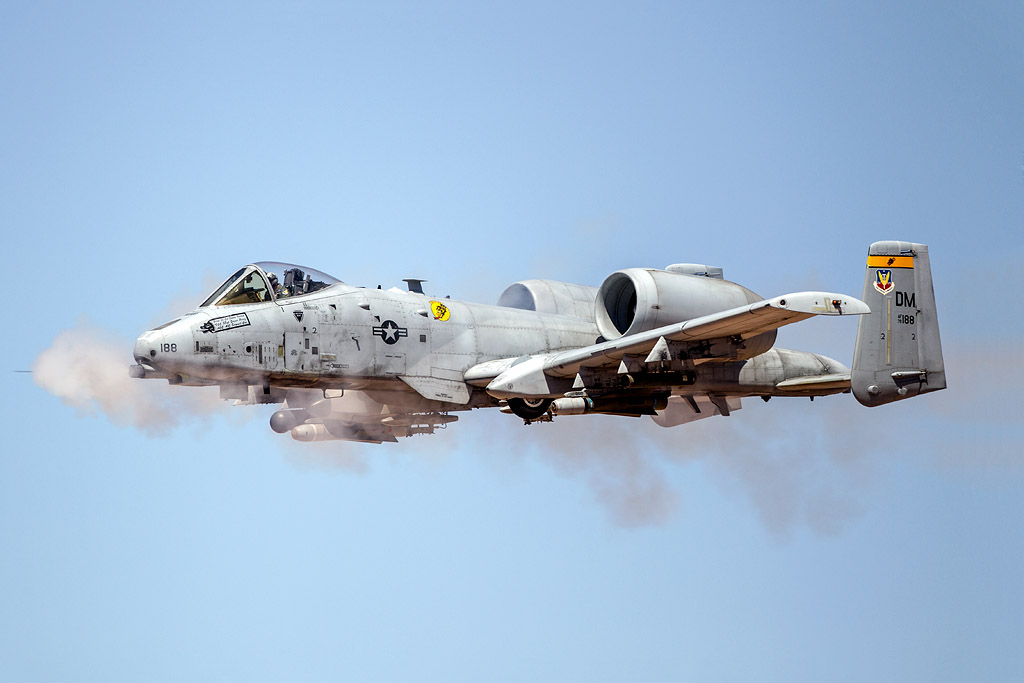
BMGR is divided into two sectors; the western part (BMGR-W) is controlled from MCAS Yuma and is mainly used by the F/A-18 Hornets and AV-8 Harriers from the same base. The eastern part (BMGR-E) is controlled from Luke Air Force Base and is mainly used by A-10 Thunderbolt II from Davis Monthan AFB and F-16 Fighting Falcons from Luke AFB.


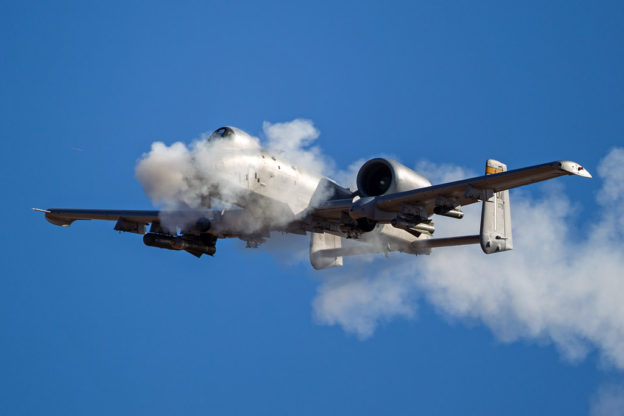
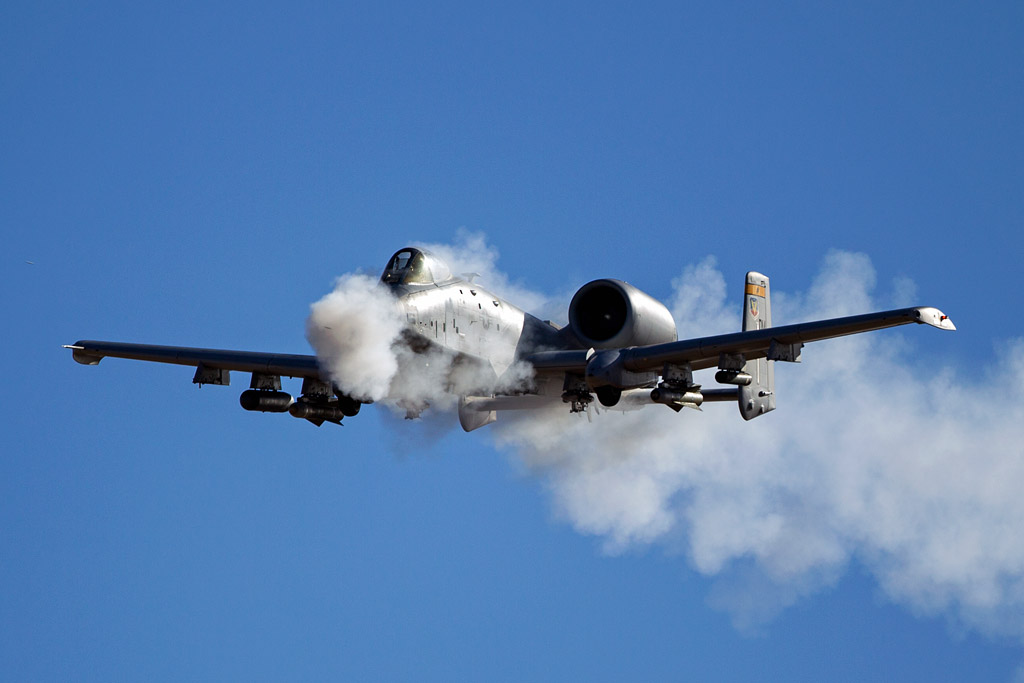
It’s not because that there’s anything wrong with the A-10.
It’s just the big 30mm GAU-8 / A Avenger Gatling gun being used extensively,
creating a cloud of smoke around the plane.
A pair of targets on BMGR. This is among other things,
those the pilots are aiming for when they do their target practice.

Barry M Goldwater Range – East
At the beginning of 2013, FLYMAG visited the 56th Range Management Office at Luke AFB to learn more about the Barry M Goldwater Range-East.

BMGR-E consists of three main areas: The shooting area (BMGR-E), Gila Bend Air Force Auxiliary Air Field and the 56th Range Management Office at Luke Air Force Base. Together, these three areas form a complete training system for both student and experienced pilots.

The eastern part of the BMGR is approximately 4,000,000 square kilometres and contains among other things, four manned shooting ranges, three simulated bombing areas and several locations where air combat can be practiced.

The facilities in the range can cope with many different types of missions. On the four manned shooting ranges pilots can practice dropping conventional bombs and even engage ground targets with a gun.

Manned shooting ranges
Each of the four manned ranges consists of:
  • A fixed target which can be used for both unguided bombs and guns
  • “Banner” targets which can be used for gun strafing
  • A manned tower where a controller controls the aircraft using the shooting range
  • An unmanned turret which is used for triangulating bomb impacts on the fixed target

When a group of aircraft are going to use one of the four manned shooting ranges, they must first get permission from the air traffic controller in charge of the area. The flight of aircraft will often be flown by an instructor pilot and up to three student pilots being trained in the use of unguided bombs and strafing.

The airmen fly in a circular pattern above the shooting range so that they can then peel off one at a time and drop bombs or shoot with the gun. Typically, they start by using small blue ballistic training bombs (BDU-33) against a stationary target. Approaches can be done from different heights and dive angles depending on what needs to be learnt.

“Dry runs”
Usually, one or two so-called “dry runs” are carried out to start with. This is where the target is approached but no bombs are dropped or shots fired. After the dry runs, pilots call “In hot” over the radio, meaning they will drop a practice bomb or fire their gun. Practice bombs are the BDU 33, which simulate a Mk-82 bomb.

In order to assess the pilot’s precision, the BDU 33 is equipped with a small powder charge, which emits a cloud of white smoke when the bomb hits the ground. Mounted on top of both the manned and unmanned turrets is a video camera which points towards the stationary target. Images from these cameras are sent live to the 56th Range Management Office at Luke AFB, colloquially called “Snake Eye” and through triangulation, the precision of the bomb impact can be determined quickly (more on this later in the article).

Bomb distance and direction from the stationary target is sent via radio to range controller, who then tells the pilot how close he was to scoring a direct hit. All this happens in less than ten seconds and before the next flight is ready to make its approach on the target.

When practicing with a gun, shots are taken at either the stationary target, usually a well-worn decommissioned armoured vehicle or on the banner targets located next to the manned turret. In order to assess the pilot’s precision with the gun, there are a number of highly sensitive microphones placed around both the targets.
“After the dry runs, pilots call ”In hot”, over the radio, meaning they will drop a practice bomb or fire their gun.”
Simulated bomb areas
These microphones are able to determine how many shots were fired and where these shots struck. As with dropping practice bombs, the altitude and angle of attack depends on the training needed for each pilot on the mission. There are often attacks from several different heights and angles. The distance from which shots are fired also varies.

The three simulated bomb areas contained within BMGR-E consist of “cities” made up of old freight containers. These are used to train pilots to find the correct building while using their infrared target acquisition equipment, so that they drop their laser-guided bombs onto the correctly targeted building within a town.

Gila Bend Air Force Auxiliary Field
Gila Bend AFAF is located just outside BMGR and acts as a diversion airfield for the aircraft using the range, so that if an aircraft has engine trouble or encounters other problems, it does not have to fly far before it can land. There are no aircraft permanently stationed at the base, but foreign units, both fixed-wing aircraft and helicopters, regularly deploy to the base when training at BMGR.

In addition to its function as a diversion airfield, Gila Bend is also used for storage and maintenance of the targets and scoring systems used on BMGR. In a storage area of the base, there are rows of old military aircraft and vehicles that either have been used as targets or are due to be used when the current ones need replacement.

To make the training as realistic as possible, there are established targets that simulate enemy radar systems at various locations around BMGR. From the control room at Luke Air Force Base, “Smokey SAM” rockets can be launched when aircraft approaches. These rockets are made of foam and are about forty cm tall.

When they are fired they create a long tail of smoke which is either black or white, depending on the type of engine in the rocket. At the same time, the radar simulator will activate and give the pilot a warning in the cockpit that a missile has been fired at him. He will then have to spot the missile and make the correct evasive manoeuvres.

To increase the realism of the training for the pilots who will be responsible for attacking enemy SAM batteries, a mock-up of an SA-6 missile system has been built, with both radar and launchers. This makes it more realistic when the pilots need to search for and identify targets using their infrared target acquisition equipment.


After his “run” against the targets, this A-10 breaks away from the area,
before the next A-10 comes in for his run.
 
The sharp shooting with gun on BMGR is practiced in many ways, from different
heights and angles. Here is an A-10 shooting from the relatively high altitude.

Realistic training
Modern warfare is constantly evolving, and the people around BMGR work hard to improve the training opportunities the pilots have, in order that they are best prepared for battle. One of the needs that has arisen in recent years is to attack small moving targets with an aircraft’s cannon.

Since it of course is too dangerous to order a poor recruit to drive a car through the desert whilst being shot at, so it was also thought to be to easy for the pilots if a car was installed on a rail and pulled back and forth along the same route day in, day out. Therefore, the staff at BMGR developed a full size remote-controlled car. The car is not controlled locally, but all the way from Luke AFB.

Such a car is not cheap and as a consequence, the pilots do not aim for the car itself, but for a triangle of tyres pulled behind the car at a safe distance. The wire used to tow the tyres comes from an old target-towing pod. With the car being remote controlled, it means that it can be driven far more aggressively and take more wild evasive manoeuvres depending on the pilot being trained.

To ensure that the car has high survivability, there are restrictions on what flight angles a pilot must shoot from. None of the pilots are allowed to fire from an angle of forty degrees in front of or behind the car.

BMGR currently has two refurbished remotely controlled Ford Explorer SUVs that can be utilised by Luke AFB.

Range Management Office – Luke AFB
Everything that happens on BMGR-E is controlled by the 56th Range Management Office, called “Snake Eye” in everyday speech, which is based at Luke AFB, about 150 km from BMGR-E. This is where the whole scoring system is controlled, radar simulators operated, Smokey SAM’s are fired and the remote controlled car is steered from. This is also where the pilots that have been out on the shooting range eventually come for a thorough debriefing after mission.

When air-to-air missions are flown, the aircraft is equipped with an Air Combat Manoeuvring Instrumentation (ACMI) pod. This long thin pod is mounted on one of the aircraft’s weapon pylons and collects data about the aircraft’s speed, altitude, direction and so on. This information is streamed live to Snake Eye, where those who control the exercise from the ground can see a 3D image of the air battle taking place.

All data from the exercise is saved and can be seen by the pilots after the mission. Here they have the opportunity to review the mission in great detail, among other things, a computer generated “this is what you saw from your cockpit at the time” image for each pilot, so that pilots get the most out of the debriefing. Should the connection to Snake Eye fail, all data is stored in the ACMI pod and can be downloaded manually after the mission.


It’s not only sharp shooting that the pilots are practicing when they are on BMGR.
There is placed various moch-ups of Russian military vehicles that pilots can use
their targetpods on, at nearby Gila Bend AFAF.
 
Everything that happens on BMGR-E is controlled by the 56th Range Management
Office, called “Snake Eye” in everyday speech, which is based at Luke AFB

Advanceret teknologi
Assessing pilot precision with BDU-33 practice bombs uses, as mentioned earlier, triangulation via two video cameras mounted on towers out on the shooting range. These cameras transmit live images back to an operator in Snake Eye, who sees the images from the two cameras on a split screen.

When the software detects the white puff as the BDU-33 practice bomb hits the ground, the screen freezes. Then the operator uses a joystick to drag a line over the cloud of smoke on the top screen. With a click of the button on the joystick, the cursor moves down to the lower part of the screen where the cloud of smoke is again marked with another click.

The software can then calculate how far from the target and in which direction the bomb landed. The distance and direction are reported via radio to the range controller at the shooting range, who then tells the pilot the results. This rapid feedback enables the pilot to make any adjustments needed during his next attack.

A big thank you to Teresa Walker, Public Affairs Specialist, 56th Range Management Office, Luke AFB, and Mr. Chuck “Taco” Gutierrez, Chief, Air & Range Operations, 56th Fighter Wing, both of whom made this article possible.

Nordic Fighters – F17 Ronneby

Nordic fighters – Sverige


Den første del i denne mini-artikel serie, som handler om de nordiske fighters. Den første del handler om det svenske luftvåben.
AF: SØREN NIELSEN
F17 Kallinge historie
F17 Kallinge blev etableret oven på Bredåkra mosen ved Kallinge under navnet Kungliga Blekinge Flygflottilj d. 1 Juli 1944. 2 eskadriller, kendt som 171. stridsflygdivisonen, og 172. stridsflygdivisionen i dag, blev samtidig dannet under F17. Eskadrillernes primære opgave var at samarbejde med flåden i anti-skibs missioner. Dette passede fint til placeringen, som blev valgt da det tidligere havde været et militært område, dog kun brugt af flåden.

Eskadrillerne startede med at flyve B 3 (Junkers Ju 86D-1). I 1947 gik de over til at flyve marine versionen af flyet Saab 18. I 1960′erne blev der tilføjet to nye eskadriller til F17. I 1964 ankom division RB 68 (Bloodhound MK II, anti luft missil batteri), og i 1965 en Search and Rescue (SAR) helikopter eskadrille. Anti luft missil batteri eskadrillen var kun aktiv indtil 1974, da hele systemet i flyvevåbnet blev udfaset og blev sendt tilbage til Storbritannien.

I forbindelse med nedlukningen af ?F3 Malmslätt i 1972, blev der i 1973 tilføjet to jagt divisioner fra F3 til F17. Enhederne blev lavet om til at være dedikerede jagt eskadriller indtil 1978, hvor en jagt division blev udfaset og erstattet med en rekognoscerings division fra F11 Nyköping, som efterfølgende blev udfaset i 1980, efter forsvarsforliget af 1977. Spaningsdivisionen var den første på F17, der fløj med den bevæbnet udgave af Viggen, i form af SF/SH Viggen.

F12 Kalmar var også en af de flyvestationer, som Riksdagen besluttede at lukke i 1980, efter forliget i 1977. F12 havde et sektorspecifik ansvar over sektor S2, som dækkede den sydøstlige del af Sverige, og luftforsvar centret kaldet Vargen (Ulven), dette ansvar blev overført til F17. I 1978 overtog F10 Ängelholm hele SektorSyd, hvilket betød at de overtog al luft overvågning af det sydlige Sverige. Hos F12 Kalmar lå flyvevåbnets vejr skole (VädS) placeret, denne enhed indgik i F17, som et detachement under betegnelsen F17K, frem til 1982, hvor skolen blev flyttet til F5 Ljungbyhed og alle militære aktiviteter i det tidligere F12 ophørte og afsluttet.

Tooled up, og klar til kamp. JAS-39 er et meget alsidig kampfly.
 
Det er ikke kun missioner, hvor det handler om “fire-power”, som JAS-39 kan bruges i.
En anden vigtig rolle er blandt andet rekognoscering.
Flyvestationens jagt divisioner
I 1982 blev flyvestationens jagt divisioner, bevæbnet med JA 37 Viggen. Efter forsvarsforliget i 1992, skulle F13 Norrköping i løbet af 1993 overføre en jagt / angreb division fra F13 Norrköping til F17, mens der også blev sendt en rekognoscering division til F10 i Ängelholm.

I forbindelse med forsvarsforliget af 2000, skulle F10 i Ängelholm lukkes den 31. december 2002. I forbindelse med forliget, blev det besluttet at F17 skulle overtage JAS 39A Gripen fra F10 i Ängelholm og dets detachement i Hästveda (F10H). Det samme forsvarsforlig besluttede også at F16 Uppsala skulle lukkes, hvilket inkluderede de to F16 afdelinger: F16 Malmen på Malmens lufthavn (F16M) og F16 Gotland i Visby lufthavn. Disse afdelinger blev overført til F17 under betegnelserne henholdsvis F17M og F17G.

I 2004 begyndte eskadrillerne at få erstattet deres JAS-39A version med C-versionen. I forbindelse med forsvarsforliget i 2004 blev Flygbasjägarskolan (FBJS) overført fra F7 Såtenäs til flyvestationen. Endvidere ankom den tredje helikopter eskadrille (3. hkpskv), til F17. Den tredje helikopter eskadrille er kun co-lokaliseret på flyvestationen, og er et detachement til Försvarsmaktens helikopterflottilj (Hkpflj), på Malmen.

2011 var også året hvor F17 blev sendt til Libyen i forbindelse med FL01 (Flyginsats Libyen), som var den første internationale fly mission siden F22 Congo (22 U.N. Fighter Squadron, 1961-1963). 2011 blev også det sidste år eskadrillen fløj A-versionen af JAS 39 Gripen, da 172. stridsflygdivisionen blev opgraderet i juni måned til C-version.

F17G Gotland
F17 Gotland (F17G ) har siden 2003 været en afdeling af F17 baseret på Gotland. Afdelingen blev oprettet som en detachment af F13 Norrköping i 1956, ved Visby Airport på Gotland, navngivet F13 Gotland (F13G ) med henblik på at støtte Flygvapnets faciliteter på øen. Samme år blev der bygget en ny start og landingsbane i asfalt. I 1957 blev F13 Norrköping tildelt ansvaret for Gotlands luftförsvarssektor (G 1). Sektoren kom i 1965 til at blive kombineret med F13s anden sektor O 1. I 1981 blev sektor O 1 og O 5 lagt sammen til en ny sektor, Sector Mitt, der dækkede hele mellem Sverige. Sektoren ledes af F16 Uppsala.

Flyvestationen kom først til senere, og i flere omgange. Den skulle tilpasses til forskellige formål, 1965 til Bas 60 , i 1975 til JA 37 Viggen, i 1992 til Bas 90, og i 1995 til transportfly.
I forbindelse med den store lukning af flyvestationer, der fandt sted i 1990′erne og begyndelsen af 2000′erne, kom detachementets vigtigste ændring i løbet af flere etaper. I 1994, da F13 Norrköping blev lukket som en konsekvens af forsvarsforliget af 1992, blev detachementen overført til F16 Uppsala, og blev udpeget F16 Gotland (F16G).

Da F16 Uppsala blev lukket i 2003 på grund af forsvarsforliget af 2000, blev detachementet overført til F17 Kallinge og fik sit nuværende navn F17 Gotland (F17G). QRA – Quick Reaction Alert, kaldet afvisningsberedskabet (AVB) i Danmark, er en af de vigtigste roller for F17G i dag, da Gotland ligger midt i Østersøen, og det er derfor et af de mest østligste luftrum i Sverige.
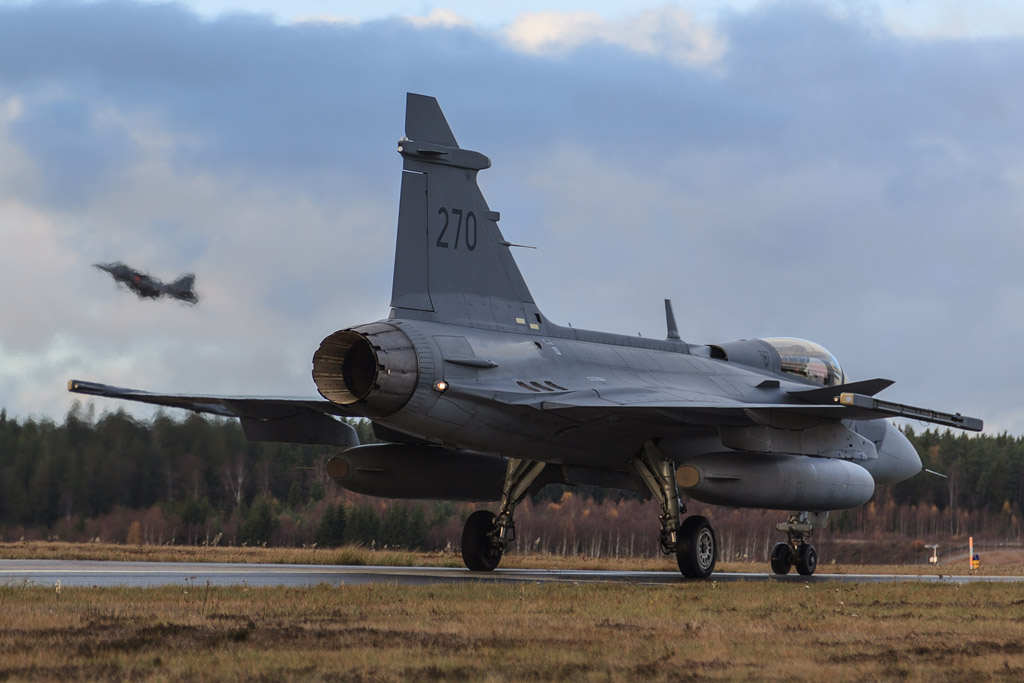
En våd bane, et flot eftermiddagslys, og en JAS-39C der bremser i flotte omgivelser.
JAS-39C’s canards fungerer som effektive bremser.
 
“I forbindelse med forsvarforliget af 2000, skulle F10 i Ängelholm lukkes den 31. december 2002
Gruppechef for 172:a Stridsflygdivisionen Capt. Mattias ”Shooter” Olin,
står foran sin jet inden næste trænings mission skal til at starte.

QRA
Døgnet rundt, hver dag, hele året, er der et QRA beredskab på standby, klar til at beskytte Sverige territoriale integritet.

Baggrunden for det svenske beredskab er Sovjetunionens nedskydning af en svensk DC-3 over Østersøen i 1952, som blev efterfulgt af den såkaldte Catalina nedskydning, da en Catalina der ledte efter DC-3 også blev skudt ned af Sovjetunionen.

Konsekvensen af disse begivenheder var, at Sverige indførte en kontinuerlig overvågning af luftrummet samt et beredskab, der kan fungere mod eventuelle krænkelser af luftrummet.

I dag har Försvarsmakten altid fightere i beredskabet. Det betyder ikke, at der er fightere i luften døgnet rundt – noget, der ville være ekstremt dyrt og personalekrævende (-intensitivt). I stedet indgår en vurdering af situationen, som er grundlaget for om kampflyet skal i luften, eller forblive på jorden i forskellige grader af standby.


Sverige har hele tiden flyvere klar til beskytte deres territorium.
QRA – Bevæbnet jagtinstinkt
Den hurtigste måde at afvise en ubuden gæst på, enten på himlen eller på havoverfladen, er at sende Försvarsmaktens fightere i luften. Sveriges land, hav og luftrum overvåges af forskellige sensorer, såsom radarstationer fra forskellige steder døgnet rundt. Ved den mindste antydning af, at de ukendte fly eller skibes aktiviteter forekommer på eller nær det svenske territorium, vil interceptors blive scrambled, for at kontrollere hvad der sker, og gøre opmærksom på at de trodser svensk territorium, og om nødvendigt afvise eller stoppe de ubudne gæster. Dette kan gøres ved at piloten giver tegn med sine hænder, vipper flyveren, eller om muligt via radioen. For at mindske risikoen for fejl og utilsigtet optrapning af situationen, findes der et sæt nationale og internationale regler der skal overholde.

Normalt gennemføres QRA-beredskab med to fly, hvis automatiske kanoner altid er skarptladte Det er fordi piloterne har brug for at kunne have våben som det ultimative middel til afviste et andet fly. De bør også altid have mulighed for at forsvare sig selv eller deres wingman. Visse andre nationers QRA fly bærer også missiler, men normalt gør de svenske QRA fly ikke, hovedsageligt fordi der ikke altid er en trussel, der kræver det, men der er også gode grunde til, at der ikke altid er et godt tegn at vise sig for et andet fly med missiler på sine vinger.

På ethvert givet tidspunkt er omkring 2.000 skibe i Østersøen, foruden alle private både, fritidssejlere og marinefartøjer. I luften er det ikke mindre trængt, foruden alt nationalt og nordisk civil luftfart, går så går den store flyrute mellem europas største lufthavne og forskellige asiatiske destinationer igennem den sydlige del af Østersøen. Derfor patruljerer rekognoscerings beredskabet de svenske grænser og det international luftrum i vores nabolag, for at se og dokumentere de skibe, luftfartøjer og igangværende militære øvelser. Overvågningen gøres ved brug af forskellige sensorer, såsom flyets radar og rekognoscering pods, hvilket i praksis er et stor digital kamera med high-end objektiver.

Hver identifikation eller afvisning bliver altid dokumenteret ved brug af radar, radio og GPS. I QRA flyet er der også altid et håndholdt kamera, som gør det muligt for piloten at tage foto til senere analyseret af specialuddannet personale på jorden. Teknisk udstyr gør det muligt også at foretage identifikation i mørke.

F17G Gotland
Overtrædelse af Sveriges grænser sker et vist antal gange om året. Nogle af disse overtrædelser viser sig at være fejl fra piloternes side, og sommetider er det en administrativ fejl, såsom en planlagt og godkendt overflyvning , men hvor oplysningerne af en eller anden grund er blevet forlagt . Uanset hvad årsagen er, så registreres og dokumenteres alle de begivenheder relateret til svensk territorium og luftrum. Ved indikation af, at noget ukendt nærmer sig de svensk grænser vil et øge beredskabet sættes i værk, og et afventende spil går i gang, indtil at QRA flyene får besked på at gå i luften. Det højeste beredskab en besætning på jorden kan få, er at piloterne skal sidde i flyet med motoren kørende, indtil andet er blevet beordret.

Jaktstridsledaren tager beslutningen om indsatsen og giver instruktioner til piloterne under gennemførelsen af afvisningen. Han sidder normalt i en af kommandocentralerne sammen med fighter lederen og luft overvågningen, og har et godt overblik over situationen der bliver udspillet i luftrummet. Når afvisnings flyet nærmer sig luftfartøjet, der overtræder det svenske luftrum, vil piloten dreje hovedet på forskellige måder, for at skabe kontakt med den anden pilot. Hvis luftfartøjet ikke adlyder ordrer eller besvarer igen på kommunikationen, kan jaktstridsledaren give godkendelse til at et varslings skud med den store automatkanon, for at vise det krænkende luftfartøjet at dette er seriøst, samt for at prøve at skabe kontakt. Noget der dog ikke er sket i moderne tid.

Efter kontakten er optaget til luftfartøjet, vil det enten vende om, hvis det intet har at gøre i svensk luftrum, eller også vil det blive identificeret, for så efterfølgende at fortsætte sin flyvning i det svenske luftrum.

F17 Kallinge har QRA beredskabet for den sydlige, samt østlige del af Sverige. Dette sker i form af 2 JAS-39C både F17 Kallinge – Blekinge AB, samt 2 JAS-39C på F17G Gotland, i Visby lufthavn.


En siluet af en JAS-39 igang med en fuld afterburner take-off.
JAS-39 Gripen
De fleste kan huske, og savner, den store og mægtige Viggen. Savnet blev skiftet ud med gode minder, da Swedish Air Force Historic Flight fik sendt deres J-37 Viggen ”Gustav 52” på vingerne igen. Mange af piloterne på F17, har fløjet både Viggen, og Draken, og selv om mange, mest af nostalgiske årsager, savner Viggen og Draken, syntes alle at JAS-39 Gripen er en fantastisk flyver. I forhold til Viggen giver Gripen mange flere muligheder, for både piloter og mission planners, da Gripen har en klar forbedring i flyve egenskaberne i forhold til Viggen. Foruden denne forbedring er den største forbedring, at JAS-39 er en swingrole flyver, kontra Viggen, som var en singlerole flyver.

Da man er gået fra en singlerole til en swingrole flyver, har det også betydet en ny hverdag for piloterne, da de nu skal lære tre ting. Hvor de førhen kunne koncentrere sig om en enkelt mission, skal alle piloter nu kunne klare både Fighter (Jagt), angreb (Attak) og rekognoscering (Späning), og antallet af træningstimer er ikke blevet tredoblet. Heldigvis er JAS-39C Gripen flyet udstyret med et topmoderne cockpit, og et computersystem der gør at piloten let kan skifte mellem de tre missions typer, og kun få vist de informationer som er nødvendige for den valgte missions type.

Den fysiske størrelse på Gripen, forbedret aerodynamik og moderne fly-by-wire teknologi har gjort at flyve egenskaberne er blevet meget bedre i forhold til Viggen. Den mindre størrelse har også gjort cockpittet mindre, og piloterne har derfor mindre plads til at operere flere systemer end de skulle i Viggen. Her kommer det moderne cockpit design med multi funktions touch skærme til sin ret, og gør piloterne i stand til at flyve alle tre typer missioner på trods af det forholdsvis lille cockpit.

Alle de svenske JAS-39’ere er blevet opgraderet fra A/B modeller til C/D, hvilket yderligere har øget kapaciteten og mulighederne. Den største forbedring må anses for at være air-to-air refueling kapaciteten, som benytter ”probe and drouge” systemet kendt fra bla. US Navy’s fly. Denne kapacitet gør at det Svenske flyvevåben nu er i stand til at deployere Gripen flyet til baser langt uden for Sverige, ligesom de taktiske muligheder er blevet væsentligt forbedret.

Eskadrillechef Andreas Dahlberg, som tidligere selv har fløjet både Draken og Viggen, flyver i dag JAS-39 Gripen, ser frem til at de i enheden får ”Next generation” Gripen, JAS-39E/F, da den yderligere øger kapaciteten, muligheder og de typer missioner som de er i stand til at udføre – selv om han dog ikke er sikker på at han stadig flyver til den tid, fortæller han med et smil på læben.

Opgraderingen til JAS-39E/F, også kendt som Gripen NG, kan man sammenligne med opgraderingen af ”Legacy” Hornets (F/A-18A/B/C/D) til Super Hornets (F/A-18E/F), hvor opgraderingen blandet andet inkluderer udvidelse af antallet af hardpoints, forøget motorkraft samt nye og forbedrede avionics. Gripen NG er i stærk konkurrence med F-35 Lightning II (JSF), Eurofighter Typhoon og F/A-18E Super Hornet om at afløse F-16 i RDAF, og dermed blive Danmarks nye kampfly.

Øvelser
Foruden den daglige træning på Blekinge AB, så spiller nationale og internationale øvelser en stor rolle i piloternes og det øvrige mandskabs træning. Det er vigtigt for alle dele af eskadrillen at holde sig klar, og være i stand til at samarbejde med andre enheder, end blot dem selv. Dette gælder svenske, så vidt som det gælder internationale enheder. Dette hjælper ikke blot samarbejdet mellem enhederne, men også imellem de deltagende lande, og hjælper dem med at være parate til eventuelle fremtidige internationale missioner.

Den største udfordring ved deltagelse i fremtidige øvelser, er et meget stramt forsvarsbudget, hvilket gør at penge er den største spiller for at få puslespillet med øvelser til at gå op.

Indsatsen over Libyen, Operation Odyssey Dawn, var dog et tydeligt eksempel på, hvor forberedt de svenske enheder var til at samarbejde med den internationale koalitionsstyrke, og hvor vigtige internationale øvelser er.
 
“Den største udfordring ved deltagelse i fremtidige øvelser, er et meget stramt forsvarsbudget, hvilket gør at penge er den største spiller for at få puslespillet med øvelser til at gå op”

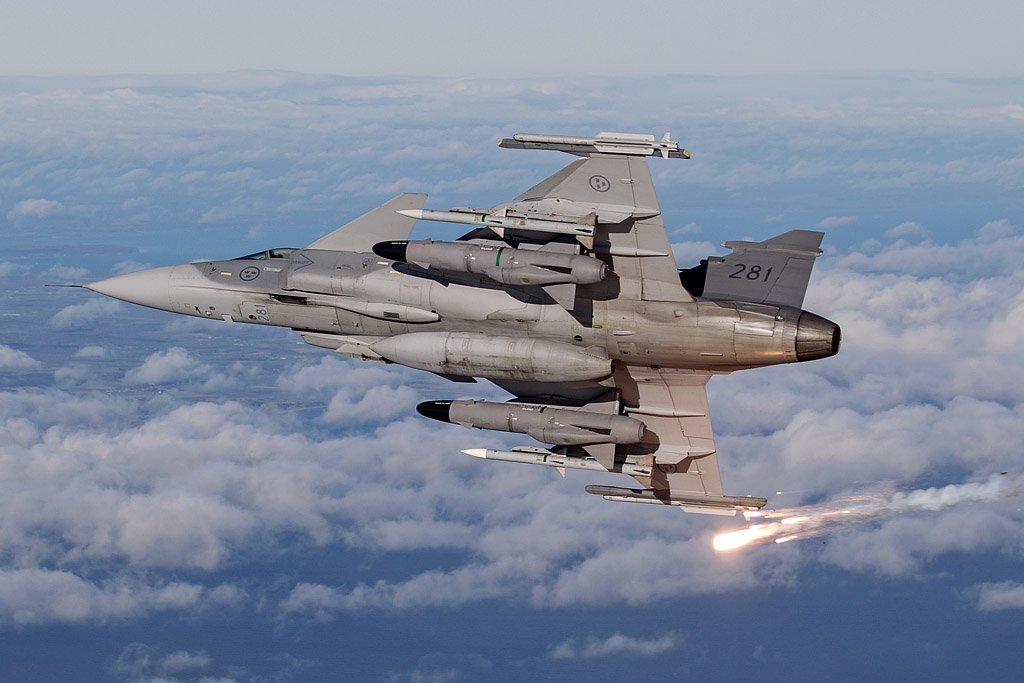
Her kan man tydeligt se armeringen på JAS’en, mens piloten skyder flares, eller ‘facklor’ som det hedder på svensk.
Libyen – Operation Odyssey Dawn
Der gik mindre end 24 timer fra beslutningen var truffet i den svenske regering, til den svenske indsats, i form af JAS-37C Gripen flyvere fra F17, landede på NAS Sigonella på den italienske ø Sicilien.

En reaktionstid der satte Sverige på det internationale verdenskort, og de beviste endnu engang at de er en vigtig spiller i det internationale samfund.

Det gik så hurtigt med at etablere denne deployment, at da de første JAS-39’ere lettede fra Blekinge AB, vidste de endnu ikke præcist hvilken base de skulle flyve til. De vidste blot at de skulle flyve sydpå.

I starten stod missionerne hovedsageligt på air-to-air patruljering, dog blev det hurtigt lavet om til at det hovedsageligt var rekognoscering missioner, som de svenske JAS-39 udførte.

Det var ikke kun de svenske Gripen der havde base på NAS Sigonella. Amerikanske, canadiske, tyrkiske samt danske styrker var også baseret på basen, og dette gav et godt sammenhold mellem landene. Specielt nævnte eskadrillechef Andreas Dahlberg, at de fik stor hjælp af det danske luftvåben under opstarten af deres missioner fra NAS Sigonella.

Red Flag
En stor logistisk udfordring, er måske ikke det første man tænker på, når man tænker på den store Red Flag øvelse, som bliver afholdt flere gange om året, på henholdsvis Nellis AFB i Nevada, og på Eielson AFB i Alaska. Eskadrillechef Andreas Dahlberg fortæller at organisering af transport og materiel til og fra Nellis, er omkring 50% af selve øvelsen, når man tænker på det som en helhed.

F17 deltog i 2013 i Red Flag 13-2 på Nellis AFB. Det svenske luftvåben har tidligere deltaget ved Red Flag øvelser, dog adskilte Red Flag 13-2 sig på flere områder. Øvelsen markerede den første gang at der blev fløjet så lange stræk med JAS-39, som ved hjælp af en KC-10 Extender, blev fløjet via Lajes over Atlanten, og derefter direkte videre til USA. Førhen har de på sådanne flyvninger skulle flyve over Island, Grønland, Canada og videre med flere stop i USA. Udover at det var første gang med den lange færgeflyvning, var Red Flag 13-2 også første gang hvor alle piloter, ground crew m.m. kom fra samme enhed. Tidligere har det været en blanding fra forskellige enheder når det svenske luftvåben skulle deltage i Red Flag.

Enheder skal selv medbringe alt det materiel de skulle få brug for, hvilket blandt andet inkluderer reservedele, f.eks. hele reserve motorer, og de live-våben de skulle bruge under øvelsen. Dette kunne lade sig gøre ved, at de havde lejet en AN-124 til at transportere reservedele, en svensk C-130, som skulle transportere de live-våben der blev brugt under øvelsen, samt en KC-10 fra USAF, som skulle stå for lufttankningen af flyverne på deres tur frem og tilbage fra Nellis, og som foruden dette kunne transportere ekstra reservedele, ground-crew og piloter.
“Det svenske luftvåben har tidligere deltaget ved Red Flag øvelser, dog adskilte Red Flag 13-2 sig på flere områder.
JAS’en er altid klar til næste mission.

Øvelse gør mester
Færgeflyvningen til og fra Red Flag var en stor del af øvelsen, da air refuelling først er blevet en mulighed efter opgradering til JAS-39C. Det var et bevidst valg at flyve de lange strækninger med tanker for at træne refuelling, og færge flyvningen blev en stor succes. Det var en blanding af både unge, og erfarne piloter, som deltog ved denne øvelse, og med en succesrate på omkring på 75% af alle missionerne, må dette beskrives som en succes, når man tænker på øvelsen som helhed. Succes raten starter lavere, men som øvelsen skrider frem forøges denne rate betydeligt.

Eskadrillechef Andreas Dahlberg forklarer at der er mange områder hvor Red Flag adskiller sig fra andre øvelser, og størrelsen er en af dem. Man kan virkelig mærke at der sidder 2.000 mand på Nellis AFB, hvis eneste opgave er, at planlægge og afvikle øvelsen. Dette er noget man ikke ser andre steder i verden. Til sammenligning fortæller eskadrillechef Andreas Dahlberg at det er flere end der er ansat på Blekinge AB.

Øvelses området omkring Nellis er så stort og tilbyder så mange ting, som ikke er muligt i nært samme omfang andre steder. En af disse ting er ”Large Force Packages”. Begrebet Large Force Packages dækker over at det er muligt at have mere eller mindre alle aspekter af et virkeligt krigsscenarie med i øvelsen, ved at du har de store bombere, electronic warfare, overvågning, air-to-air, air-to-ground, jord enheder m.m. med i samme øvelse, og endda i samme mission og scenarie. Dette gør at øvelse virker endnu mere realistisk, end hvis det blot var air-to-air der blev trænet.

Øvelsesområderne er ikke blot kæmpe områder hvor det er muligt at flyve både hurtigt og lavt, men områderne er spækket med forskelligt udstyr, hvor blandt andet deres ground-to-air systemer, er meget avancerede, hvilket klart er en fordel frem for andre øvelsesområder rundt omkring i verden, da det udsætter piloterne for så realistiske scenarier og situationer som overhovedet muligt, uden at der bliver skudt med skarpt efter dem.

Red Flag missionerne består både af air-to-air, air-to-ground og CAS, dog var andelen af CAS missioner på Red Flag 13-2 lidt for stor, i forhold til hvad der var håbet på fra F17’s side. Red Flag er også kendt for deres Aggressor enheder, som eskadrillechef Andreas Dahlberg beskriver som meget effektive og professionelle, som Red Force modstandere.
International kvalitet
En vigtig del med disse øvelser er, foruden at træne piloterne, samarbejdet med de forskellige koalitionspartnere. Selvom Sverige ikke er en del af NATO, deltager Sverige i store koalitions opgaver, og øvelser. Deltagelsen i flere Red Flag øvelser, samt deres store indsats i Libyen missionerne har sat Sverige på kortet, som en vigtig international partner.

Foruden de 3-4 større nationale og internationale øvelser, som F17 deltager i om året, er det målet for F17 at de i fremtiden skal deltage i Red Flag en gang hvert 2. eller 3. år.

En stor tak til Gruppechef på 172:a StridsflygdivisionenCapt. Mattias ”Shooter” Olin, samt Eskadrillechef på 172:a Stridsflygdivisionen LtCol Andreas ”Dalle” Dahlberg for at muliggøre denne artikele.

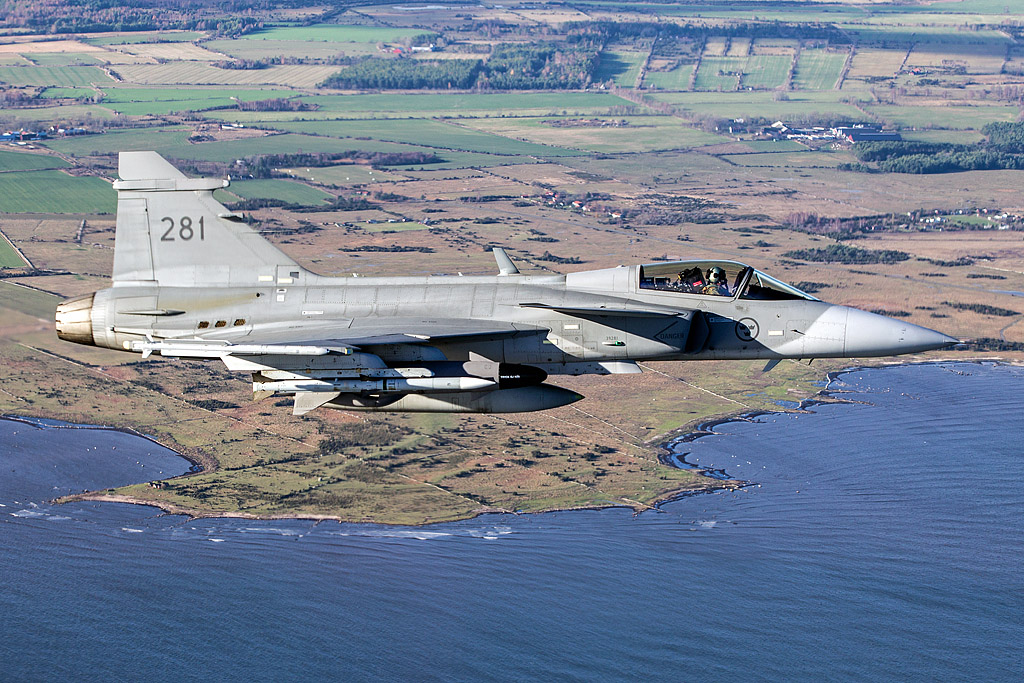
Spidsen af Öland, sol og JAS-39C Gripen drejer af for at komme retur til F17 Blekinge AB.

WTI – Training the trainer

Weapons and Tactics Instructor


Twice a year, the seven week Weapons and Tactics Instructor (WTI) course is held at Marine Corps Air Station (MCAS) Yuma, Arizona.
BY: SØREN AUGUSTESEN
WTI – Training the trainer
Twice a year, the seven week Weapons and Tactics Instructor (WTI) course is held at Marine Corps Air Station (MCAS) Yuma, Arizona. The main objective of the course, as the name suggests, is to train weapons and tactics instructors for the Marine Corps. Only the most experienced pilots are selected to gather at Yuma for the WTI course as it is used to increase their knowledge over and above their existing training certifications. This means that they will become experts in their chosen field which then means that they can act as squadron-level instructors when they get back to their units.

To be selected to participate in WTI, the pilot needs to be recommended by his immediate boss and then meet a number of stringent requirements. The chosen pilot must have a required number of certified skills that can only be obtained by undertaking a large number of flying hours and land based courses. Something that separates WTI from other instructor courses is that it assembles the best pilots from all aircraft types that the USMC utilises. This means that during the exercise, MCAS Yuma will be home to a variety of aircraft types that do not normally operate from the base.

Normally, MCAS Yuma is home to the umbrella organisation Marine Air Group 13 (MAG-13):
  • Marine Fighter Attack Squadron 121 “Green Knights” (F-35B Lighting II)
  • Marine Attack Squadron 211 “Wake Island Avengers” (AV-8B Harrier II)
  • Marine Attack Squadron 214 “Black Sheep” (AV-8B Harrier II)
  • Marine Attack Squadron 311 “Tomcats” (AV-8B Harrier II)
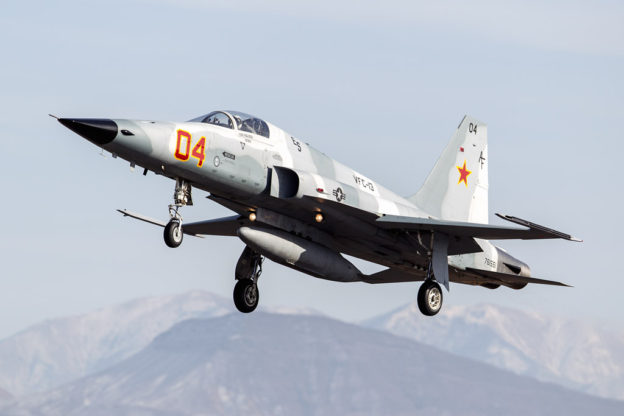
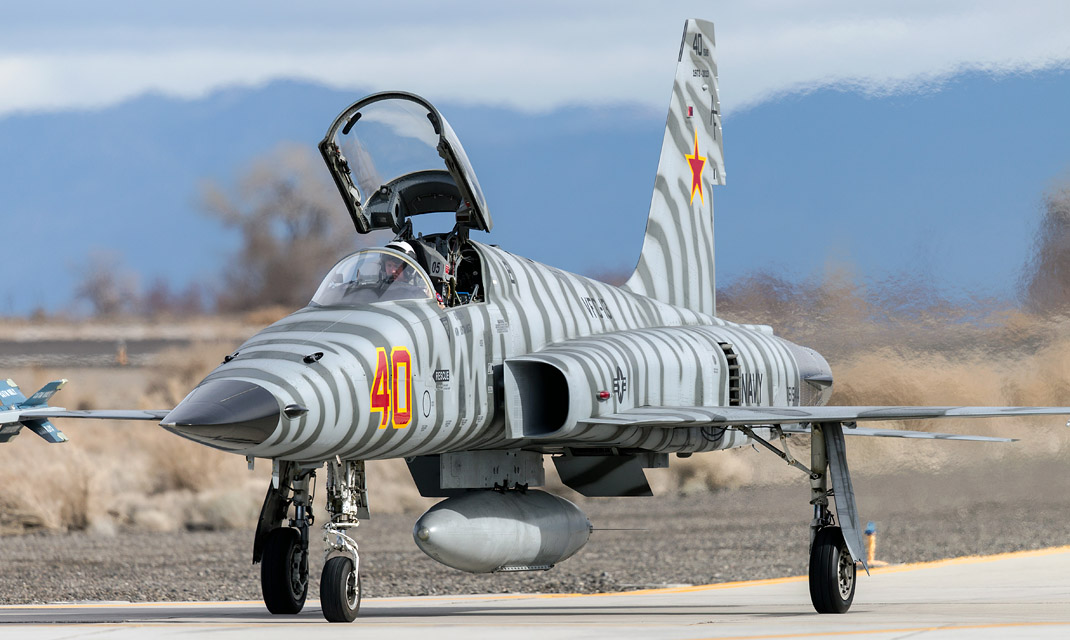
  • Marine Fighter Training Squadron 401 “Snipers” (F-5N Tiger II)

During the WTI course, all the other aircraft and helicopter types at the disposal of the USMC arrive at MCAS Yuma including the F/A-18 Hornet, EA-6B Prowler, KC-130 Hercules, MV-22 Osprey, UH-1Y Huey, AH-1Z Viper and CH-53E Super Stallion along with AV-8B Harriers from other units than those home-based at Yuma.

The old CH-53E Super Stallion helicopters still plays a major transport role in the USMC, and they are used intensively during WTI.
 
An AH-1 Cobra is heading in for the landing, in the background is part of the
MV-22s that’s participating in the WTI course.


The course
During the course the pilots have a unique opportunity to train together as well as with many other ground crews. A WTI course will typically include approximately ninety aircraft and helicopters plus 4,500 personnel. This means that the WTI can run missions at a much higher level of complexity than is normally possible for the individual units.

The first 3 1⁄2 weeks of the course is academic with the final 3 1⁄2 weeks being the practical exercises. The first academic week is spent giving students the bigger picture of what the aviation assets of the USMC can do. At the end of the week the pupils go through a course in risk management. This is done so that when they get back to their units, they can help their superior officers to make decisions about the risks associated with training flights and missions in the real world.

In week two, students are divided into groups according to what types they fly. Helicopter pilots will run a series of classes together on issues that are relevant to all varieties of helicopters and winged aircraft pilots will run a series of classes that are relevant to their equipment.

In the third week, students are divided further into groups by type. They then run a number of lectures specific to each aircraft. These lessons include both looking at the systems on board each aircraft, the types of weapons that are available and how these systems and weapons can best be used in combat. When this part of the WTI is over, the focus moves from the academic to the practical phase where the students put into practice all they have learnt in the classrooms.

The practical part
In the third week, students are divided further into groups by type. They then run a number of lectures specific to each aircraft. These lessons include both looking at the systems on board each aircraft, the types of weapons that are available and how these systems and weapons can best be used in combat. When this part of the WTI is over, the focus moves from the academic to the practical phase where the students put into practice all they have learnt in the classrooms.

In the first week of the practical course, students continue in the same groups from the last week of the academic part, ensuring that pilots of each aircraft type train together. This means that pilots feed off each other’s ideas whilst learning to master all the weapons systems and tactics they had learned during the study periods.

In week two of the practical course, the pilots begin flying with other aircraft types. Again, they are split up by fixed wing and rotary types flying together. At this stage there will not be any mixed missions whereby jets and helicopters fly the same mission. This week is to enable the students to learn the tactics behind the missions.

In the third and final practical week, it all becomes merged and all types fly with everyone, so that fighter pilots learn the tactics behind flying missions with helicopter pilots and vice versa. A WTI course involves approximately 230 students and an instructor staff of around ninety. However, more instructors can be brought in as befits the need. These instructors will all be former WTI pupils.

Occasionally, there will be students from other countries on a WTI course. During April 2013, there were pilots from the Royal Air Force, Royal Australian Air Force and Royal Canadian Air Force taking part. Pilots and aircraft from the US Navy and US Air Force also participate in relevant phases of a WTI course when needed.


An EA-6B Prowler landing at MCAS Yuma. The replacement for the Prowler as USMC electronic warfare aircraft, hasn’t been decided yet.
“Occasionally, there will be students from other countries on a WTI course. During April 2013, there were pilots from the Royal Air Force, Royal Australian Air Force and Royal Canadian Air Force taking part.
MAWTS-1
The main purpose of the air component of the USMC is to provide air support for ground troops and this is a recurring theme throughout the WTI course. There is also a full battalion of Marines involved in the practical part of the WTI course to participate in many of the missions that in particular, the helicopter pilots are flying. In addition, they also implement other exercises whilst they are at Yuma in order to maximize their benefits from the time at the base.

WTI exercises are organized and managed by Marine Aviation Weapons and Tactics Squadron One (MAWTS-1). MAWTS-1’s history can be traced back to the period after the Second World War when the first Marine pilots began operating from Navy aircraft carriers. In order to achieve the best training the decision was made in the early 1950s to create so-called Special Weapons Training Units (SWTU) on both the east and west coasts.

In the 1960s, the use of conventional weapons was added to the training syllabus in the SWTU. Over time, the SWTU’s grew larger and were renamed the Marine Air Weapons Training Units (MAWTU), being located at MCAS Cherry Point in North Carolina and MCAS El Toro in California.

In 1975, a commission was established to examine how the training of Marine pilots could be improved and made more efficient. This work resulted in the formation of the WTI exercises, the aim of which was to train Marine pilots to be instructors for their colleagues in their home unit.

In the autumn of 1976 and spring of 1977, WTI courses were held at both MCAS Cherry Point and MCAS El Toro. In May 1977 and February 1978, the first two combined WTI courses were held at MCAS Yuma, Arizona. Due to the great success of the combined WTI course at MCAS Yuma, MAWTS-1 was created at MCAS Yuma on June 1, 1978.

When MAWTS-1 is not conducting the WTI courses, the instructors travel to Marine Corp units around the world. Here they teach, among other things, some of the certifications needed to be eligible for the main course. Moreover, it is MAWTS-1 which is responsible for updating all the training manuals that are used by Marine Corp flying units and they are also responsible for developing and updating the tactical manuals.


“When you are so close to the target, you can actually hear a hissing sound in the air a few seconds before the bomb hits its target.
A laser-guided bomb captured in the split second before it hits its target. It shows how accurate modern laser-guided bombs are. The ground crew pointed their laser,
and aimed for the “window” to the right of where the bomb hits
There is also being used with live ammunition during the WTI course. The picture
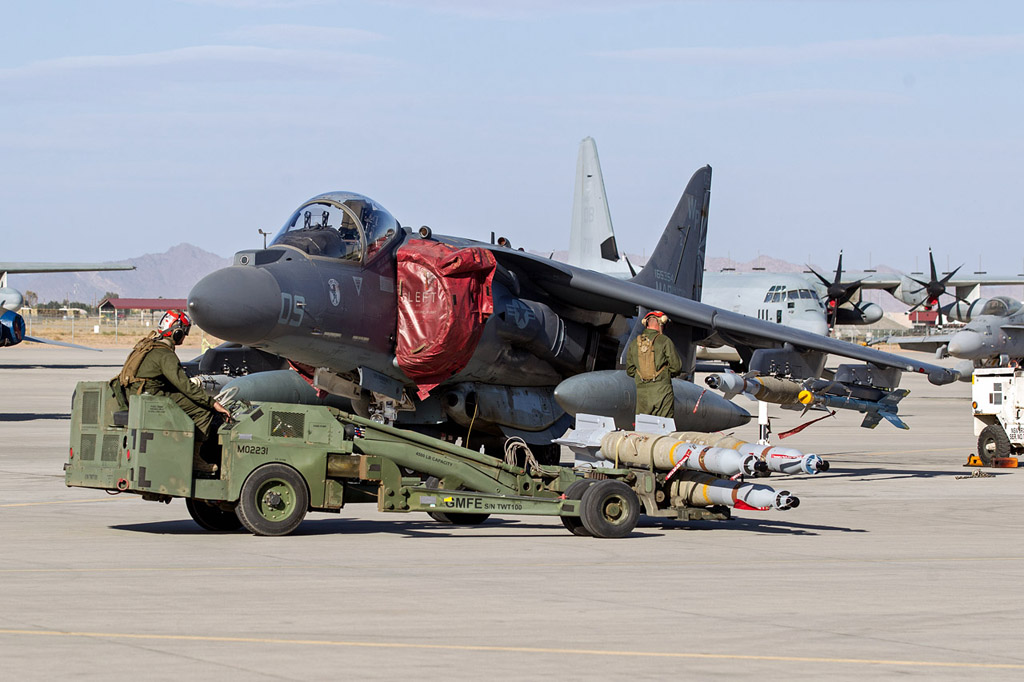
above shows the ground crew preparing to load an AV-8B Harrier with live ammunition.

Yodaville
Just outside of Yuma, near the Mexican border, is one of the USMC’s training areas. Inside the exercise area, is the town called Urban Target Complex (R-2301-West), which is known to the Marines by the far easier title of Yodaville – named after the radio call sign of the pilot who had the idea for the city, Major Floyd Usry. The city is made ​up of containers stacked in multiple levels, with streets, painted doors and windows. The city is used to train Close Air Support (CAS) in urban areas and it is the first of its kind in the United States.

During a WTI course, Yodaville used to train both the Forward Air Controllers (FAC) and pilots in CAS in urban areas. The FAC who is undergoing training is on the ground within Yodaville. The instructor with them points out which targets in the city that needs to be hit, for example, a particular window in a building. Then it is the FAC’s task to explain to the attacking pilot circling above the city which target is to be struck. The pilot then illuminates the target with his laser pod and drops a laser-guided practice bomb at the target, hopefully hitting it correctly.

To make things a bit more realistic, a group of Marine foot soldiers take up positions with heavy machine guns next to the FAC team, ready to “defeat” different targets within the city. This teaches the FAC to call in air support while shots are being fired around them. Likewise, there are also troops with simulated heat-seeking surface-to-air missiles nearby, so pilots can come “under fire” while they carry out their attacks.

It was explained that when you are so close to the target, you can actually hear a hissing sound in the air a few seconds before the bomb hits its target. One can also clearly see the precision with which modern precision weapons can hit their targets, often with laser-guided bombs cutting through the containers less than one meter from the chosen window the FAC designated. This kind of precision is required when providing CAS in urban areas and the training that both the FAC’s and the pilots get in Yodaville is obviously invaluable when they are sent to war zones around the world.

Humanitarian Aid/Disaster Relief
One of the final elements of the WTI course has long been known as Non-combatant Evacuation Operation (NEO), designed to train pilots to retrieve American civilians from an area where they were in danger.

From the WTI course in April 2013, this part was changed to a Humanitarian Aid/Disaster Relief (HA/DR) exercise. The purpose of this was to simulate a humanitarian response to a disaster area. The exercise takes place in a small local park not far from MCAS Yuma and the object is to fly personnel and supplies into a zone where there has been a humanitarian and/or natural disaster. This is a type of mission that the USMC are more and more frequently tasked to perform around the world and therefore it has been included in the WTI in order to optimize the tactics used.

As mentioned, the HA/DR exercise takes place in a small local park rather than one of the major training areas that are otherwise abound the Yuma area as this gives the pilots far more realistic training in how to fly and land in civilian areas where there are many more obstacles that must be taken into account during the approach, for example trees, lamp posts and traffic on the ground.

For the pilots landing in the park, there is not much difference between NEO and HA/DR. Those who feel the biggest difference are the troops on the ground. Now it is no longer just a matter of getting a group of civilians on board the helicopters, but to also unload a large amount of equipment from the helicopters once they have landed, whilst also keeping the area secure and safe.

The first task is undertaken by the large CH-53E Super Stallion helicopters flying in the Marines that are tasked with securing the landing area and to keep the local population at a safe distance so that the subsequent helicopters can land safely. Once the area is secured and a ring of soldiers has been formed around the landing area, two landing spots are marked and the next two helicopters are called in. At the same time, two UH-1Y Huey helicopters circle above to provide support from the air if it is required.
“The first task is undertaken by the large CH-53E Super Stallion helicopters flying in the Marines that are tasked with securing the landing area, and to keep the local population at a safe distance so that the subsequent helicopters can land safely”
A large CH-53E during landing in the small park in the middle of Yuma,
during the HA / DR exercise.

One of the many marines securing the area, while 2 CH-53E Super Stallions are moving into the area with new supplies.
The samaritans
The next to land at the park are doctors and their medical equipment, the plan being that a treatment centre will be set up close by where they can treat injured people. A steady stream of CH-53 helicopters’ then arrive two-by-two landing at the park landing site. When they have landed and the dust has settled, they are unloaded by soldiers on the ground as quickly as possible so that their time in the park is minimized.

During our visit amidst the flow of CH-53 helicopters, there was suddenly a lot of noise and commotion when a group of “locals” tried to penetrate the secure area. As per their training, the Marines in charge of security quickly got the situation under control by stopping them from entering and detaining them so that the operation could continue smoothly.

As darkness began to fall, there was a report of an injured soldier and it was therefore necessary for one of the two UH-1Y Huey helicopters to land and pick up the wounded Marine.

The exercise continued even after nightfall, where the large CH-53 helicopters continued to land two by two in the now dark park. All-in-all, the whole exercise was not only good for realistic training for the USMC personnel, but it also gave the local population of Yuma a fine opportunity to see the USMC in action.

Large thanks are due to Cpl. William Water-Street, Public Affairs, MCAS Yuma, and MAWTS-1 for enabling this article to be written.

Russian Air Force – 100 års jubilæum

Russian Air Force fejrede 100 år


100 års jubilæet af det russiske luftvåben blev fejret med et helt igennem fantastisk airshow på Zhukovsky basen.
AF: SØREN NIELSEN
Russian Air Force fejrer 100 år
Der er i disse år en del lande, der fejrer 100 år med militær flyvning, enten i form af at deres luftvåben i sig selv har 100 års jubilæum, eller som Danmark, hvor det var markeringen af 100 år med dansk militær flyvning, der blev fejret.

Vores nordiske naboer har også fejret 100 års jubilæum i år for deres luftvåben, og endnu en jubilar er at finde længere mod øst, nærmere bestemt Rusland.

Det russiske luftvåben (VVS – Voyenno- vozdushnye sily Rossii) fyldte 100 år i år, og det skulle fejres med et stort show i august på Zhukovsky basen, lidt uden for Moskva. Zhukovsky danner også rammen for MAKS, der afholdes hvert andet år.

Airshow på Zhukovsky
Showet så meget spændende ud fra den første deltagerliste kom frem. Men det var ikke nemt at få klare informationer omkring, hvordan begivenheden skulle forme sig.

Til at starte med blev det annonceret at det ville være en begivenhed over 2 dage, lørdag og søndag, som ville være åben for alle. Et par uger efter kom der et rygte om at om fredagen ville der være mulighed for at pressen kunne komme ind og overvære rehearsal showet. Blot en uge senere kom det frem at Ruslands præsident, Vladimir Putin ville komme til showet, og dermed var al adgang for offentligheden lukket af.

Som vi nærmede os show datoen i august, var det stadig meget uklart om begivenheden overhovedet ville være åben for offentligheden, eller om det, som først rygtet, var en lukket begivenhed, som kun var for nuværende og tidligere militært personale. To uger før showet kom der en hjemmeside, hvor det var muligt at tilmelde sig for at få en invitation, således at man havde mulighed for at komme ind til showet. Der var dog det lille problem at registreringssiden ikke accepterede udenlandske pasnumre!

Heldigvis kom der en ny side, hvor det var muligt for udlændinge at tilmelde sig for at få en invitation, hvilket, i første omgang, var som at en af de vigtigste brikker faldt på plads. Det skulle dog vise sig, at for at få billetterne til selve showet, skulle man personligt møde op på et billetkontor i det centrale Moskva, 2 timer i bil væk fra showet, inden for 48 timer efter man havde fået invitationen, for vise sit pas for at få udleveret billetter til showet.

Selve begivenheden endte med at være over 3 dage, rehearsal dag fredag, lukket show for Putin lørdag, og den offentlige fejring søndag – hvor det var muligt at få billetter til.


Lipetsk har et bredt arsenal af forskellige flyvere, her ses 4x Su-24M,
som en del af ‘Fighter’ forbiflyvningen.

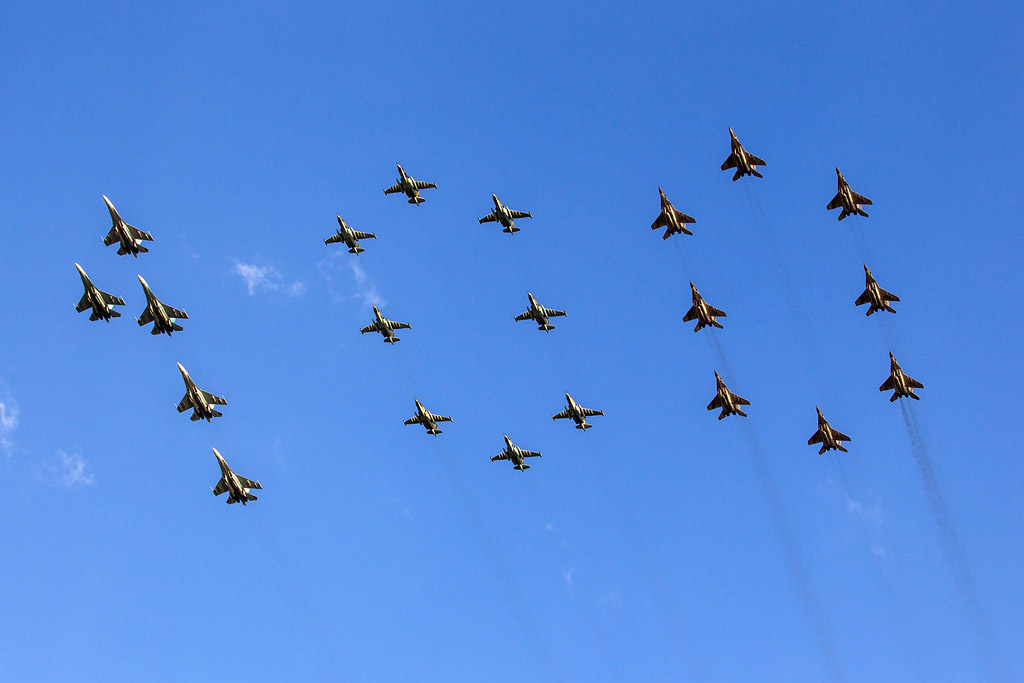
“Tæt forfulgt af fem Su-27, otte MiG-29, og otte Su-25 i en perfekt ‘100’-formation.”
Super Flankeren, Su-35 og dens 2 NPO Saturn 117S thrustvectoring motorer, gav en opvisning man sent vil glemme, med manøvre man ikke troede var muligt at udføre af et fly.
Showdagen
Opvisningen startede kl 10:30 med faldskærmsudspringere over Zhukovsky, der viste det russiske flag, det russiske forsvarsministeriums flag og flaget fra det russiske flyvevåben. I en fantastisk hyldest til 100 år for VVS, var der seks Su-25’ere med hvid, blå og rød røg, de russiske nationale farver, tæt forfulgt af fem Su-27, otte MiG-29 og otte Su-25 i en perfekt ‘100’-formation. Publikum jublede og klappede i påskønnelse af dette mesterværk af en flyvende koreografi – og det var blot en lille smag af ting at komme.

‘World Legends of Aviation’
Den næste del af opvisningen var navngivet ‘World Legends of Aviation’ og indeholdt forskellige historiske fly, såsom Bleriot, Tummelisa, Po-2, TBM Avenger, F-4U Corsair, Catalina, C-47, Yak-3, Yak-9 , Yak-11, MiG- 3, Polikarpov I-15, Hurricane, B-25 Mitchell, Harvard, P-40 Kittyhawk og P-51 Mustang. De fleste af disse fly var fløjet ind fra forskellige samlinger i Europa. Men det mest bemærkelsesværdige var dog en sølv farvet MiG-15UTI, som havde en fantastisk livlig opvisning.

Jet noise!
Lyden fra de gamle motorer blev knust af lyden af efterbrændere fra den helt fantastiske Sukhoi Su-35 der lettede og trak lige op i en lodret stigning. Denne super ‘Flanker’ i sin unikke lizard splinter bemaling lavede en opvisning af sin uovertrufne manøvredygtighed, takket være sine 2 NPO Saturn 117S thrust-vectoring motorer. Opvisningen bestod blandt andet af kontrollerede spins, cobras og manøvre man blot tænker at et fly ikke skal kunne lave.

Opvisningshold
Publikum blev derefter budt på kunstflyvning i form af et solo display af en Su-31, ‘Team Russ’ der fløj L-39 Albatros jet træner og det eneste russiske professionelle piston engine kunstflyvnings hold ‘First Flight’ – flyvende i Yak-52/54. Af udenlandske opvisningshold var blandt andet, de britiske Red Arrows, de finske Midnight Hawks, polske Team Iskra og Frecce Tricolori fra Italien.

Red Arrows fløj en unik opvisning bestående af kun seks fly, da et af deres holdmedlemmer var nødt til at vende tilbage til Storbritannien på grund af sygdom i familien. Red Arrows flyver normalt ni fly, men i år er de reduceret til syv fly. Storbritanniens stolthed blev tiljublet af tilskuerne på grund af, at de vendte den normale rækkefølge af deres røg farver til istedet at danne de hvide, blå og røde farver, som af det russiske flag.

Golden Eagles
En anden unik årsdag blev også fejret på Zhukovsky, nemlig 20-årsdagen for Berkut (Golden Eagles) helikopter display teamet. Efter tidligere at have fløjet Mi-24V Hind-E kamphelikoptere, havde holdet for nylig overgået til den frygtindgydende Mi-28N Havoc – en to-sædet anti-panser angrebs helikopter som deres display helikopter.

Displayet består af en seks skibs formation, som senere bliver opdelt i en diamant af fire helikoptere til nogle dynamiske manøvrer. ‘Havoc’ displayet blev senere fulgt op af solo Mi-2 ‘Hoplite’ og Ka-52 ‘Alligator’ (Hokum B) demo. Det karakteristiske 2 bladet rotor design af Kamov ‘Alligator’ viste sig særdeles manøvredygtig, selv med sin sidemonteret kanon og de fastmonterede vinger, med seks våben stationer.


Berkut (Golden Eagles) helikopter display teamet flyver i dag 6x Mi-28N Havoc. De har tidligere fløjet Mi-24V Hind-E, men er for nyligt skiftet over til Havoc’en.
Russian Knights og Swift flyver i tæt formation, efter at en regnbyge har passeret og solen igen skinner.


Unikke formationer
De store bombeflyveres forbiflyvning fra baserne på Engels og Chaikovka var en af de mest ventede dele af denne hundredårs fest.

Den unikke formation af tre Tu-22S, tre Tu-95S, og tre Tu-160S var virkelig noget af et syn, kun forstærket af den vidunderlige lyd af de tolv Kuznetsov NK-12M turboprops på Tu-95S ‘Bear’. Transportfly forbiflyvning var også ekstraordinære, den omfattede tre An-2’ere, en An-26, An-140, An-12, An-22 samt en An-124.

Den eneste udenlandske moderne kampfly i den flyvende del af opvisning var det franske Air Force Rafale C, som var en god forandring fra alle de støjende og rygende MiG’er! Men klart ikke det vi var kommet for at se. Rafalen havde også kun lige rørt landingsbanen efter sin opvisning, da den næste formations forbiflyvningen allerede kunne ses i det fjerne. Mere russisk transport, denne gang fra den nærliggende base Chkalovsky, der udførte deres hyldest med en Let-410, Tu- 134UBK, tre Il-76s plus en ultra sjælden Il-80VKP luftbårnen command and control fly, efterfulgt af en Beriev A-50 AWACS.

Displayet består af en seks skibs formation, som senere bliver opdelt i en diamant af fire helikoptere til nogle dynamiske manøvrer. ‘Havoc’ displayet blev senere fulgt op af solo Mi-2 ‘Hoplite’ og Ka-52 ‘Alligator’ (Hokum B) demo. Det karakteristiske 2 bladet rotor design af Kamov ‘Alligator’ viste sig særdeles manøvredygtig, selv med sin sidemonteret kanon og de fastmonterede vinger, med seks våben stationer.

Et af højdepunkterne
Vi var nu kommet til endnu en af højdepunkterne på dagen, forbiflyvningen af fighters. Og her blev man ikke skuffet over denne gruppe forbiflyvninger. Fra deres baser i henholdsvis Borisoglebsk, Lipetsk, Savasleyka og Voronezh var fire Yak-130, fire Su-24, fire MiG-31 og fire Su-34. Alle disse ‘Fencers’, ‘Foxhounds’ og ‘Fullbacks’ gjorde hele rejsen, og den kamp det havde været for at komme derover, det hele værd.

Der var knap nok tid til at få trukket vejret før lyden af rotorer kunne høres. Den enorme Mi-26 heavy transport helikopter dukkede op, flankeret af fire Mi-8s, efterfulgt af et par Mi- 35s, og derefter passerede tre Kazan Ansat utility helikoptere.

Stilheden bredte sig efter helikopterne var ude af opvisnings området, men den stilhed blev pludselig brudt af ankomsten af fire MiG-29 fra Astrachan, der ville vise hvordan en dogfight skulle udføres.

Flyvende i “Fulcrum-A ‘varianten af denne air superiority fighter, delte de sig straks op i par og udført en mock-up luftduel foran publikum. Og hvilken luftduel det var! Flares og tæt formation hvor 2 MiG-29 jager 2 andre MiG-29 – kan det fåes bedre?


Lipetsk forbiflyvningen bestod af 4x Su-34, 4x Su-27 og 2x MiG-29
‘Fighter’ forbiflyvningen indeholdt mange spændende flyvere, f.eks. disse 4x MiG-31
fra Savasleyka.

Røgen i horisonten
Det kunne det! Mere sort røg i horisonten varslede ankomsten af en anden fighter. Denne gang var det Lipetsk’s tur til at forbløffe publikum. Fire Su-27, fire Su-34 og to MiG-29 ankom i formation, hvor de efterfølgende lavede et split i de enkelte typer. De to MiG-29 kom tilbage, og lavede en fantastisk opvisning, i tæt formation og crossovers lige foran publikum.

De overgav derefter himmelen til de fire Su-34, som kom tilbage i formation, for at lave et break foran publikum, hvorefter en ‘Fullback’ kom tilbage for at demonstrere magt og smidighed af Ruslands nye tunge Strike Fighter.

De fire ‘Flankers’ ville vise deres kollegaer fra Astrachan og deres MiG-29 hvordan en rigtig luftduel skulle kæmpes, og den fik ikke for lidt, med tæt formation og masser af flares. Disse to luftdueller var en af mine helt klare personlige favoritter. De sluttede denne fighter finale af med at lave noget formationsflyvning, og til sidst et climb i formation, mens der blev skudt flares ud af ryggen på alle 4 ‘Flankers’.

Vi havde set de nuværende typer af VVS, og nu var det på tide at få et glimt af fremtiden. I talrige passager i formation med en to-sædet MiG- 29M2 ‘Fulcrum-E’ var den seneste tilføjelse til det russiske arsenal, Sukhoi PAK FA T-50 femte generation fighter. I en tre tonet grå splinter bemaling, fremviste ‘Prospective Airborne Complex of Frontline Aviation’ (PAK FA) sine stealthy linjer.

Pragt finalen!
Finalen til showet blev overladt til stjernerne fra Kubinka, nemlig Strizhi (Swifts) og Russkije Vityazi (The Russian Knights), der udførte præcisionsflyvning til perfektion.

Den fælles Su- 27 og MiG-29 formation fløj ind forbi publikum sammen og blev derefter opdelt i de enkelte teams, som begge to udførte fantastiske opvisninger, i både formations og soloflyvning – og ved hjælp af en masse flares. Især en manøvre fra 4 Su-27’ere der splitter op, flyver i hver deres retning og flyver lodret op, indtil de står stille i luften og laver et tailslide mens de skyder flares ud af ryggen. Imponerende, og mindre imponerende er det ikke når opvisningsholdene består af MiG-29’ere og Su-27’ere.

Mens publikum stadig klappede og The Knights samt Swift forlod himlen over Zhukovsky, var prikken over i’et på vej ind, i form af MiG-29’ere, Su-27’ere og Su-25’ere fra Kursk, Krymsk og Buddenovsk i deres ‘100’ formation, fulgt tæt efter med en formation bestående af ni Su-25 fra Lipetsk, igen i farverne på det russiske flag.

Dette markerede afslutningen på en lang, men imponerende dag. En af de begivenheder jeg altid vil kunne huske.


En Su-27 fra Russian Knight laver tailslide mens der bliver skudt flares ud af ryggen på denne ‘Flanker’ – hvilken en helt enestående opvisning det var.
“Endnu mere imponerende var at den blev overholdt til punkt og prikke.
Imponerende præcision
Imponerende var listen til det flyvende display, og endnu mere imponerende var at den blev overholdt til punkt og prikke. Alt foregik på minuttet som det var skrevet:
  • 10:30 Parachuting with the Russian flag, flags of the Russian Defense Ministry and the Air Force.
  • 11:00 6x Su-25 Flythrough
  • 11:01 ‘100’ Flythrough – 5x Su-27, 8x Su-25, 8x MiG-29
  • 11:02 World Legends of Aviation – Bleriot, Tummelisa, Po-2, TBM Avenger, F-4U Corsair, Catalina, C-47, Yak-3, Yak-9, Yak-11, MiG-3, MiG-15UTI Polikarpov I-15, Hurricane, B-25 Mitchell, Harvard, P-40 Kittyhawk & P-51 Mustang.
  • 13:11 Team Rus (6x L-39)
  • 13:27 Mil Mi-2 Solo demo
  • 13:34 Berkut Team – 6 x Mi-28
  • 13:50 Sukhoi Su-31 Solo demo
  • 14:00 Bomber Flythrough – 3x Tu-22M3
  • 14:01 Bomber Flythrough – 3x Tu-95MC
  • 14:02 Bomber Flythrough – 3x Tu-160
  • 14:03 Frecce Tricolori
  • 14:36 Transport Flythrough – 3x AN-2
  • 14:37 Transport Flythrough – AN-26
  • 14:38 Transport Flythrough – AN-140
  • 14:39 Transport Flythrough – AN-12
  • 14:40 Transport Flythrough – AN-22
  • 14:41 Transport Flythrough – AN-124
  • 14:42 French Rafale Solo demo
  • 14:51 Transport Flythrough – L-410
  • 14:52 Transport Flythrough – Tu-134
  • 14:53 Transport Flythrough – 3x IL-76
  • 14:54 Transport Flythrough – IL-80
  • 14:55 Transport Flythrough – A-50
  • 14:56 Red Arrows
  • 15:15 Kamov Ka-52 Solo demo
  • 15:23 Fighter Flythrough – 4x Su-24
  • 15:24 Fighter Flythrough – 4x MiG-31
  • 15:25 Fighter Flythrough – 4x Su-34
  • 15:26 Fighter Flythrough – 4x Yak-130
  • 15:27 The Turkish Stars
  • 15:28 Helicopter Flythrough – Mi-26, Mi-35,Mi-8, Kazan Ansat
  • 16:00 4x MiG 29 Air Battle
  • 16:08 Team Iskry
  • 16:40 Mixed Flythrough – Su-34, Su-24, Su-27,MiG-29
  • 16:41 2x MiG 29 demo
  • 16:46 Fighter Flythrough – 4x Su-34
  • 16:47 Su-34 Solo demo
  • 16:52 4x Su-27 Air Battle
  • 17:03 The Midnight Hawks
  • 17:23 3x Yak-52, 1x Yak-54 – “First flight”
  • 17:41 PAK FA Sukhoi T-50, MiG-29M2
  • 17:58 The Latvian Baltic Bees
  • 18:12 The Russian Knights and the Swifts
  • 18:29 ‘100’ Flythrough – 5x Su-27, 8x Su-25, 8x MiG-29
  • 18:30 9x Su-25 Flythrough

Opvisningen på Zhukovsky gav en mulighed for at opleve en bred vifte af fly sjældent set uden for Rusland. Det var virkelig en fantastisk begivenhed og en passende hyldest til 100-årsdagen for det russiske flyvevåben.

721 Squadron – Danish transport squadron

721 Squadron – The Challenger flight


Maritime patrol, VIP flights, and heavy transport applications are just some of the tasks that 721 Squadron handles.
In this article we look at the Challenger flight, and especially its main task of maritime patrol.
BY: SØREN AUGUSTESEN
721 Squadron
In the Royal Danish Air Force (RDAF), the job of air transport is handled by 721 Squadron, located at Aalborg Air Base in the northern part of Jutland. The base is also known as the Air Transport Wing Aalborg.

The squadron currently has a total of eight aircraft, divided into two types. To handle the heavy long-range transport missions, the squadron flies four Lockheed C-130J-30 Hercules aircraft. For smaller transports, VIP flights and maritime patrol missions, there are four Canadair CL-604 Challenger aircraft.

In this article we look at the Challenger flight and especially its main task of maritime patrol.

CL-604 Challenger aircraft
The RDAF received three Canadair CL-604 Challenger aircraft (C-080, C-168 and C-172) between 1998 and 2001. These aircraft replaced the Gulfstream III which the RDAF operated from 1982 until 2004. The Challenger was originally built as a civilian medium-range aeroplane, but the RDAF version is equipped with a lot of additional military-style equipment such radar and a comprehensive communications suite.

In addition to this, there is also the more specialized equipment used for the maritime patrol missions. The Challengers are typically flown in one of two configurations; either as a VIP transport aircraft or as a maritime patrol aircraft. In its role as a VIP transport aircraft, it carries members of the royal family, high ranking military officers and top government ministers around the world. In this configuration the aircraft cabin is equipped with comfortable leather seats.

For the maritime patrol mission, the cabin is less luxuriously equipped with two large consoles that are operated by system specialists.


The motto of the squadron shield “Ubicumque Qandocumque”, which means
“Anywhere – Anytime”.
Ready to go. The ground crew delivers the plane to the crew.

Pirate Hunting in Africa
721 Squadron’s Challenger aircraft have on several occasions participated in Operation Ocean Shield, the NATO led mission around the Horn of Africa. The purpose of Operation Ocean Shield is to hunt for the pirates operating in the region and to make it safer for merchant ships to sail through the area.

In the autumn of 2013, RDAF Challenger C-168 was deployed as part of Operation Ocean Shield. During a mission on 7 October, the aircraft suffered an engine failure shortly after take-off. The aircraft was able to return to base safely, but the engine could not be repaired on site and it was therefore necessary to send a new engine so the Challenger could resume its participation in operations.

Because the RDAF did not stock any extra engines for the Challenger, it was necessary to take an engine from one of the two aircraft that had remained at Aalborg Air Base. An engine was taken from C-080 and sent to the Seychelles, from where the Danish Challenger aircraft were operating. This meant that there was now only one Challenger left in Denmark and that had to handle all the tasks normally undertaken by three planes. This quickly proved impossible and therefore the RDAF started to explore the possibility of buying a few spare engines.

As it turned out, it was actually lower cost to buy a complete used aircraft for the same price as two new engines and as such it decided to purchase a fourth Challenger aircraft and put an engine from the new plane onto C-080 so that there again were two operational aircraft in Denmark. In February 2014, the damaged engine came back from repair and eventually C-168 and C-080 got their own engines back.

The newly purchased second-hand aircraft was integrated into the 721 Squadron inventory to relieve the other planes as necessary. It was also decided to keep it in a permanent VIP configuration so that the ground crew wouldn’t have to spend hours reconfiguring the aircraft between the VIP configuration and the maritime patrol mission sorties. The new aircraft was assigned the serial number C-215 and on the 6 June 2014, it was officially handed over to the RDAF.

Maritime Patrol
With just over 4500 miles (7300 km) of coastline and several busy international shipping lanes going through its waters, maritime patrol and surveillance is of great importance to Denmark and obviously, it is 721 Squadron’s primary mission.

In order to comply with international treaties, at least two maritime patrol missions have to be flown every week. These missions typically follow one of a number of predetermined routes which cover the inner Danish waters, the western part of the Baltic Sea and the North Sea out towards the Danish oilrigs. The main issue that the Challenger crew are on the lookout for on these missions are ships dumping oil, as this is not only illegal, but also poses a major environmental risk for the Danish coastline and marine wildlife.

On a maritime patrol mission, there are a total of five crewmembers on board the Challenger, namely the mission commander, the first officer, a flight Engineer and two system operators.

The mission commander has the overall responsibility for the planning, briefing and execution of the mission. The first officer’s job is to assist the mission commander in the cockpit during the mission. This can both be in terms of handling radio calls during the flight and also with flying the aircraft.

The flight engineer has a lot of different jobs to undertake during a mission. During take-off and landing, the flight engineer sits on a jump seat between the two pilots, where he assists with various tasks whereas during the flight, he is an extra set of eyes when an area needs to be searched visually. He is also trained to drop different pieces of kit from the Challenger, such as life rafts, markers or flares.

Speaking of which, the Challenger carries two types of markers; one with dye and one with coloured smoke. Flares are used during night missions and typically fired out at around 10,000 feet and where they will then slowly descend under a parachute. This gives the Challenger approximately five minutes to make a visual search of the illuminated area. Drops from the Challenger are made through the cargo door which is located just below the left engine. During VIP missions, the flight engineer acts as steward and waits upon the VIPs.
“The SLAR is the Challengers primary weapon in locating ships that are dumping oil.”
Visual scanning
The two system operators sit in front of their consoles in the main cabin. The left console is used to display data from the Side Looking Airborne Radar (SLAR) located under the belly of the plane. The SLAR is a SLAR 9000 and is produced by the Danish company Terma.

The SLAR is the Challengers primary weapon in locating ships that are dumping oil. The radar works by measuring the ripples on the water surface.

If there is oil present, there will not be the usual ripples on the water and this lack of motion will be picked up by the SLAR. These areas of oil pollution on the water’s surface show up as black patches on the radar screen. Besides monitoring the image from the SLAR, the system operator on the left console also has an electronic map showing the area they are currently flying over. This map shows all the commercial ships that are equipped with a transponder. Using this map, the system operator can, with a single click, see the name, speed, direction plus other information about the ship.

The system operator seated by the right hand console is in charge of most of the radio communication with ships and air traffic controllers in the regions along the route. He also controls the Forward Looking Infra-Red (FLIR) camera which is mounted in a retractable housing under the rear of the fuselage. Another of his tasks is to take photographs and video footage of any ship that is caught off-loading oil illegally.

Transferred to the police
Where a ship is suspected of dumping oil from the SLAR image, there is an established procedure for gathering the necessary evidence. First a screen capture of radar plot is made to show the exact location of the suspected ship. The Challenger then descends to low level and approaches the ship from the rear and makes a flyby, gathering further evidence in the form of photos and video footage.

After the flight has returned to Aalborg Air Base, the evidence that has been collected is transferred to the police, who are then responsible for handling the criminal charges against the ships owners.

Since the Challenger began flying maritime patrol missions around the Danish shores, the number of ships that dump oil in the area has decreased by approximately 80%.

When the Challenger aircraft are flying maritime patrol missions, it is possible that they can be contacted by Admiral Danfleet Headquarters and asked to assist in searching for people or ships lost at sea. This is a task the Challenger aircraft is very well suited for.


The two system operators held various positions during the flight,
but also complement each other if one is forced to leave his seat.
The system operator closest to the camera is responsible for radio communications,
and control of the FLIR camera, while the other monitors the image from the SLAR.
 
While on maritime patrols, it happens that the Admiral Danfleet Headquarters asks the Challenger aircraft to participate in the search for persons at sea. Here guides the Challenger one pilot boat to a man in a small boat, after he was found by the Challenger aircraft doing a SAR mission.

Search And Rescue
The search is done typically by a rapid descent to a lower altitude, typically 500-800 feet at a speed of about 200 knots, in the area where the missing person or ship is believed to be.

It then searches the area both visually and using the FLIR camera, flying a search pattern which is slowly expanded in the direction the missing persons or ship would have drifted with the wind and currents known to be in the area. This is a situation where the Challengers five man crew comes into good use. Everybody keeps a lookout for the missing persons and if needed, the flight engineer can drop a life raft and/or a marker in the vicinity of those in need.

When the missing persons are found, the aircraft descends to about 100 feet and make a fly-by to confirm that it is in fact the people they were looking for and to assess their situation. At the same time, the aircraft position is plotted and sent to the relevant authorities, who then dispatch either a rescue helicopter or rescue boat.

Intercept target for AVB
The RDAF maintains a Quick Reaction Alert (QRA) force, consisting of two F-16 Fighting Falcons at Skrydstrup Air Base in the southern part of Jutland. Their main task is to intercept and identify unknown aircraft approaching Danish airspace. The QRA force typically fly one training mission a day and if it takes place while a Challenger is on a maritime patrol mission in the area, the QRA jets will sometimes use the patrol aircraft to practice intercepts.

The Challenger aircraft are also used for maintaining Danish air sovereignty. This is because 721 Squadron is the only RDAF squadron who regularly fly over the northern parts of Greenland. Known as Air Group West, they operate from Kangerlussuaq/Søndre Strømfjord in Greenland. When flying the Challenger aircraft over Greenland, in addition to upholding the sovereignty, they also do maritime patrol missions, fishery inspection and drop equipment to the “Sirius Patrol”, the Danish Army’s special forces stationed in the northern part of Greenland.


It happens that the QRA planes uses the Challenger as “Interception-targets”.
Here are two F-16 Fighting Falcons in formation on the Challenge’s right wing.
 
The two system operators monitor the various systems aboard the Challenger.
Future of Esk. 721
With the new fourth Challenger aircraft in permanent VIP configuration, it will be easier for 721 squadron to meet the obligations which the RDAF has when it comes to the surveillance of Danish waters. It also makes the squadron less vulnerable if an aircraft must be taken out of service for longer periods of time, as happened with C-080 when C-168 lost one of its engines.

For the ground crew, this means that they will spend less time taking the marine patrol equipment in and out of the aircraft, which in turn will reduce the wear on both the equipment and the personnel.

FLYMAG would like to say a big thank you to HIF, GEA, FIR, KIM and Karl from 721 squadron, and Jesper Balle from the Air Transport Wing Aalborg, for their great help with this article.

CSAR – Combat Search And Rescue

CSAR – Combat Search And Rescue.


Who is going to rescue you, if you have to bail out of your plane far behind enemy lines?
CSAR is not a task for the faint hearted, they go behind enemy lines to rescue the survivors.
BY: SØREN AUGUSTESEN
Combat Search And Rescue
The Combat Search And Rescue (CSAR) mission, whilst being one of the most dangerous, is also one of the most important as it helps to provide the pilots who fly into combat zones with the assurance that if things go wrong, a group of pilots who are specially trained and motivated will come and get them out safely.

FLYMAG went to Davis-Monthan Air Force Base in Tucson, Arizona to learn more about the CSAR mission.

The Hog driver has started to climb aboard his A-10C, while the ground crew
preparing the “Tank killer”.
 
“The Combat Search And Rescue (CSAR) mission, whilst being one of the most dangerous, is also one of the most important.”
Davis-Monthan Air Force Base
The first airfield in Tucson was built back in 1919, but the rapid development in aviation meant that in 1927 it was moved to its current location. The airport was named Davis-Monthan after two pilots from Tucson who died in two separate aircraft accidents in the early 1920s.

The military presence began on October 6 1927, when Sgt. Simpson moved in with his fuel sales and workshop space. The first military customer was Jimmy Doolittle on 9 October 1927, and as is well known, he went on to win the Medal of Honor for his attack on Tokyo in 1942. The joint civilian and military operations ran until the early 1940s, when military needs resulted in a relocation of the civilian activities at the site.

Today, the base is home to a variety of units. During the Feid magazine visit in February 2014, the following units were noted amonst others:

355th Fighter Wing:
  • 354th Fighter Squadron (A-10C) – Bulldogs
  • 357th Fighter Squadron (A-10C) – Dragons
  • 358th Fighter Squadron(A-10C) – Lobos (shut down at the end of February 2014)

West Coast A-10 Demo Team 563rd Rescue Group:
  • 48th Rescue Squadron (Pararescue)
  • 55th Rescue Squadron (HH-60G Pavehawk)
  • 79th Rescue Squadron (C-130J)

55th Electronic Combat Group:
  • 41st Electronic Combat Squadron (EC-130H) – Scorpions
  • 42nd Electronic Combat Squadron (EC-130H) – Raptors
  • 43rd Electronic Combat Squadron (EC-130H) – Bats

943rd Rescue Group
  • 305th Rescue Squadron (HH-60G)

Due to the recent closure of A-10 Thunderbolt II units around the world, there are currently some A-10s at Davis-Monthan AFB which do not have tail code “DM”. This includes flights from Barksdale (BD), Spangdahlem (SP) and Osan (OS) air force bases.

What is CSAR?
In short, CSAR is the rescue of distressed people within a combat zone and this will typically be pilots who are shot down behind enemy lines.

A downed pilot will often be a good “trophy” to capture for the enemy force, which we clearly saw during the first Gulf War in 1991 when Saddam Hussein showed the captured Allied pilots for propaganda purposes.

Therefore, when downed pilots land in areas where locals will not greet them warmly, it is important that the pilot is picked up by friendly forces as rapidly as possible.
Meet Pedro! One of the 55th Rescue Squadron HH-60G Pave Hawk helicopters,
has been painted with a fine mustache, and has been named “Pedro”

“The first example of a CSAR mission took place in 1915 during World War 1. Squadron Leader Bell-Davies from the Royal Naval Air Service No. 3 Squadron landed behind enemy lines in his Nieuport bi-plane to rescue Flight Sub-Lt. Guilbert Smylie who had just been shot down.”
An A-10C Thunderbolt II taxis out from its sunshelter for another mission.
The missions
As was said before, another important part of the CSAR mission is to give pilots the extra peace of mind that should the worst happen and they end up behind enemy lines, then the group of highly quaified individuals that make up the rescue crews will come and get them out if it is in any way possible. This makes the pilots feel more comfortable and more willing to spend the extra time to ensure that the bomb hits the target with exceptional accuracy before they head to safety.

The first example of a CSAR mission took place in 1915 during World War 1. Squadron Leader Bell-Davies from the Royal Naval Air Service No. 3 Squadron landed behind enemy lines in his Nieuport bi-plane to rescue Flight Sub-Lt. Guilbert Smylie who had just been shot down. This showed that it was possible to save the downed pilots.

Over the next decades, during the various wars around the world, techniques and equipment to collect pilots from behind enemy lines slowly developed. During the World War II, many Allied soldiers who were forced to bail out over the English Channel were rescued by boats or seaplanes. The same was the case in the Pacific, where many American pilots were picked up by ships and aircraft too. Most of these rescues happened without hostile interference and this is therefore technically not a CSAR mission but “simply” a SAR mission.

Where the CSAR mission really came into its own and where many of the tactics and techniques used today were developed, was during the Vietnam War. During this time, the development of the helicopter reached a point where it was feasible to use it to search for and collect downed pilots, though in the early years of the war they still lacked sufficient engine power. The best known is probably Sikorsky ‘s HH-3 Jolly Green Giant which was known for the many brave rescue missions it was used in.

In the years after the Vietnam War, the HH-3 was phased out in favor of the HH-53 and HH-60G Pave Hawk helicopters, both of which were used during the first Gulf War in 1991. The Pave Hawk has also been active in all subsequent conflicts. At Davis-Monthan AFB, the HH-60G is being flown by the 55th Rescue Squadron.

HH-60G Pave Hawk
The HH-60G Pave Hawk helicopter is a development of Sikorsky’s UH-60 Blackhawk . Its primary task is to provide armed rescue services in hostile areas during both day and night.

Some of the upgrades that change a UH-60 Black Hawk into a HH-60G Pave Hawk are an air refueling probe, extra fuel tanks in the cabin that double the fuel capacity, 12.7mm machine guns on both sides of the cabin, an improved internal navigation system, satellite communications, secure data communications (Link 16), a night vision compatible cockpit and infra-red camera.

On a CSAR mission, the crew comprises a first pilot, second pilot, a flight engineer (who also mans one machine gun), a gunner and up to three Para Rescue Jumpers also known as PJs. It is the PJ who leaves the helicopter to pick up the person(s) if they cannot be lifted off by making their own way into the helicopter.

In addition, the helicopter can be outfitted with different equipment that can be used to free trapped persons from crashed aircraft.


After all checks are complete, then the A-10C Thunderbolt II from the 357th Fighter Squadron is being guided out of the shelter.
 
“Some years ago the USAF began an update program of the A-10 fleet. It comprised of new strengthened wings and an upgrade of the aircraft’s electronics.”
Two HH-60G Pave Hawks fly back to the survivors.

A-10C Thunderbolt II
Most people who are interested in military aviation know of the fearsome Fairchild Republic A-10 Thunderbolt II. This plane was specifically designed to provide air support for ground troops and literally built around the amazing General Electric GAU-8 Avenger seven barrelled 30mm Gatling gun. In addition, the plane was designed to operate in areas where it would come under heavy enemy fire.

Hence, it was heavily armoured, all important parts have backup systems including in some cases triplicate sytems. For example, two hydraulic systems are used to operate the control surfaces and these run in different parts of the plane in order to reduce the risk of both systems being hit simultaneously.

However, should this happen, the aircraft has an emergency system where it can be flown with traditional cabling. This older system is designed to give the pilot enough control of the aircraft to reach to a relatively safe place where he can then elect to land or eject in a safer manner.

Some years ago the USAF began an update program of the A-10 fleet. It comprised of new strengthened wings and an upgrade of the aircraft’s electronics. This update, known as A-10C gave the aircraft the ability to use new “smart bombs” such as the GPS guided JDAM.

In addition, the aircraft can now utilise modern targeting facilities, for example the Sniper pod, which enhance the flight options to search for and select targets on the ground. The update has also brought the plane from the analog into the digital era and has given the A-10 modern data links and secure satellite communications so that the pilot can now exchange vast amounts of information with other aircraft in the area.

357th Fighter Squadron
During FLYMAG magazine’s visit to Davis-Monthan AFB, we visited the 357th Fighter Squadron which is responsible for training new A-10 pilots and new instructor pilots as well as maintaining instructor status of the current pilots on strength.

The unit was set up in late 1942 at the Orlando Army Air Base in Florida and was first equipped with the Republic P-47 Thunderbolt fighter-bomber. The unit flew air support missions over Europe during World War II and over the years has flown P-47 Thunderbolt, P-51 Mustang , F-86 Sabre, F-105 Thunderchief, F-4 Phantom II, A-7 Corsair and is now back in the new version of Thunderbolt, namely the A-10C Thunderbolt II. The A-10 is not the first type used by the unit to train new pilots as they also flew A-7 Corsairs in this role.

The squadron has some of the most experienced and talented A-10 pilots and in 2012 was the overall winner of the Hawgsmoke competition, a competition for A-10 units which is held every two years. The squadrons compete in different kinds of bombing techniques and of course firing at targets with the 30mm cannon.


The high mountains which are well outside the city of Tucson, is creating a dramatic backdrop to the A-10 which is coming in for a landing at Davis-Monthan AFB.
 
“The unit’s motto sums up their mission very well: These Things We Do That Others May Live.”
55th Rescue Squadron
55th Rescue Squadron was established on 14 November 1952 at Thule AFB in Greenland and it stayed here until 18 June 1960 when the unit was deactivated. Thereafter followed a series of activations and deactivations on airfields around America until finally, on 22 January 2003, the unit was made resident at Davis-Monthan AFB where it has remained to this day.

The unit’s primary mission is CSAR and it has performed this task in a variety of conflicts around the world including the Panama crisis, the first Gulf war and the air war over Kosovo. The unit also performs other tasks including flights to supply disaster areas, anti-drug operations and civilian SAR missions.

Their training in CSAR missions makes them extremely proficient at performing civil SAR missions. As an example, they managed to locate a missing person in just thirteen minutes in an already explored area after civilian authorities had been searching for over a week.

The main reason for this efficiency is their in-depth knowledge of flying in pre defined scanning patterns, and the crew’s ability to spot downed people on the ground.

To perform CSAR tasks, the helicopter of choice is the HH-60G Pave Hawk which as described earlier, is a special version of the UH-60 Black Hawk helicopter. The unit’s motto sums up their mission very well: “These Things We Do That Others May Live”.

Execution of a CSAR mission
A CSAR rescue is one of the most complex mission types that exist. Partly because it typically involves many different aircraft and helicopter types, all of which perform various important tasks . Another reason is that missions are usually planned in a short period of time to be able to save the downed pilot before capture and that there may not be much data about enemy strength in the rescue area.

A CSAR mission is headed by one of the participating pilots, given the call sign “Sandy 1” – typically an A-10 pilot. It takes years of experience and training to be qualified to fly as “Sandy 1” and lead CSAR missions. A “Sandy 1” pilot must have a thorough knowledge of the strengths and weaknesses of all the other aircraft involved in the rescue operation so that he knows when and how he can best use them to get the mission completed as effectively as possible.

Because of the mission nature, where you never know where a pilot must be retrieved from and under what circumstances, it is a mission type that A-10 pilots train for a lot so that they can build up so much experience as possible.

They must be able to find fast creative solutions when they are in unfamiliar situations and as such a “Sandy” pilot typically flies ten CSAR training missions per year. This may not sound like much, but to make a CSAR training mission as realistic as possilbe requires coordination with flights from many other squadrons. In addition, training between the A-10 pilots at Davis-Monthan AFB and the HH- 60G helicopters happens on a weekly basis. There will also be exercises dedicated to the CSAR mission such as Angel Thunder held every year at Davis-Monthan AFB .
While the pilot slowly brings down the helicopter, the shooter is keeping an eye on the height out of the window. At the same time he also checks that the tail rotor is clear of
any obstacles.
 
While the pilot slowly brings down the helicopter, the shooter is keeping an eye on the height out of the window.

Getting to the downed pilots
A CSAR mission team typically consists of two HH-60G Pave Hawk helicopters, four A-10C Thunderbolt II aircraft, an airborne command centre, an aerial tanker and other fighters that are available to provide support to the land and/or air assets.

The four A-10 aircraft are typically divided into two pairs; Sandy 1 (mission leader) and Sandy 2 (his wingman), are responsible for supervising and co-ordinating the mission with the airborne command centre. It is also their task to locate the downed pilot and confirm that this is the correct person.

Which is of course a task an A-10 aircraft is extremely capable of thanks to its low speed and its phenomenal manoeuverability at low altitude. Its heavy armour and extensive armament are also a big help! A typical load-out on a CSAR mission will be two AGM-65 Maverick missiles, four bombs, rocket pods and a full load of 1,174 shells for 30mm GAU-8 cannon.

After being modernised into the new A-10C model, the Thunderbolt II aircraft has become far more effective in the Sandy role. The digitization of the cockpit and especially the addition of Link 16 data communications has made ??possible fast and secure sharing of information with other types of aircraft including AWACS and the HH-60G helicopters. All round, this has brought significant progress to the execution of a CSAR mission.

Although there has been no need to perform a CSAR mission for several years, it still remains a high priority and the training continues extensively to ensure that the crews are ready to step in if one day it suddenly becomes real and they must pick up a pilot from behind enemy lines.

The future for the CSAR missions
On February 24 the Department of Defense announced plans to phase out the entire A-10 fleet in the near future. What impact it will have on the performance of the CSAR mission is difficult to say. But the fact is that the USAF does not have a plane that can take over the role of escorting the helicopters into hostile territory, in the same way as an A-10 can.

Planes like the F-16, F-15E and F-35 simply can not fly slowly enough, or safe enough in the low altitude as it takes to escort the HH-60G’s. If the A-10 fleet will be phased out, and what in that case to take over its place will the near future tell.

FLYMAG magazine would like to thank Staff Sgt. Angela Ruiz, 355th Fighter Wing Public Affairs Office, Commander Lt. Col. Michael Curley, Major Alec Menoni, Major Joel Bernazzani and Major Daniel Haugh from the 357th Fighter Squadron and Capt. Christopher Karins, Capt. Thomas Steiner and Capt. Brian Dicks from the 55th Rescue Squadron for their great kindness and assistance during FLYMAG’s visit.
 
It is said that A-10 was designed around it’s big gun, and that it has been eye named “The Warthog”.

Red Flag – Alaska 13-3

Red Flag Alaska 13-3


Red Flag – Alaska is similar to the Red Flag held at Nellis AFB, in other words, a multi-service, multinational air combat exercise.
BY: SØREN NIELSEN
The cold north

Most who know about Red Flag will associate it with Nellis AFB just outside Las Vegas and the Nellis ranges in the Nevada desert and mountains. But it is not only here that Red Flag exercises take place. Red Flag – Alaska is similar to the Red Flag held at Nellis AFB, in other words, a multi-service, multinational air combat exercise. The exercise is under the control of the Pacific Air Forces in the U.S. Air Force. The exercise was originally known as Cope Thunder and began in 1976 at Clark Air Base in the Philippines. After the eruption of Mount Pinatubo in 1992, Cope Thunder moved to Eielson Air Force Base in Alaska and in 2006 was renamed Red Flag – Alaska.

From the beginning, the main goal of the exercise was to improve aircrew’s ability to handle the high level of stress in combat situations. While this intention has remained unchanged, the exercise has been expanded to, literally, “overwhelm the senses in simulated air combat situations”. Prior to Operation Desert Storm less than a fifth of the U.S. Air Force’s primary fighter pilots had flown in battle.

While the share of combat-experienced pilots has obviously increased in recent years, a high percentage of pilots at the time had no combat experience at all. Analysis has shown that most air combat losses occur during the first eight to ten missions. The goal of Red Flag–Alaska is to give all aircrews training in what to expect in these first vital missions in a safe training environment in order to increase their chances of survival if they ever have to fight in real combat situations.

Today both Eielson Air Force Base and Joint Base Elmendorf-Richardson (formerly Elmendorf Air Force Base) are home to Red Flag – Alaska. The exercise is a joint tactical air combat exercise which corresponds to the operational capacity of the participating units. In other words, the exercise often involves several units whose military mission may differ significantly from the other participating units.

The clouds are low and heavy over Joint Base Elmendorf-Richardson,
while this E-767 from the Japan Air Self-Defense Force taxis out.
“Analysis has shown that most air combat losses occur during the first eight to ten missions.
Red and blue
Red Flag – Alaska mission planners take these factors into consideration when the exercise is planned and organized so that the participants get the maximum amount of training without being treated less favourably than their opponents in the simulated combat scenarios.

Red Flag – Alaska participants are organized into a “Red” aggressor force, a “Blue” coalition force and a “White” neutral force that represents the neutral controlling units. “Red Force” includes air-to-air fighters, ground-control interception units and surface to air units to simulate threats from potentially hostile nations. These forces generally use defensive counter-air tactics directed by ground-control intercept sites.

Range threat emitters, electronic devices that send out signals to simulate anti-aircraft artillery and surface-to-air missiles, provide valuable ground-to-air threat training for the pilots.

“Blue Force” includes the full spectrum of U.S. and allied tactical and support units. When “Red” and “Blue” force meet in the simulated combat training area, the job of managing this simulated war and making sure everything is as safe as possible falls to the “White” neutral force.

On average, more than 1.000 people, and up to sixty aircraft are stationed at Eielson Air Force Base and a further 500 people and forty aircraft are stationed at Joint Base Elmendorf-Richardson for each Red Flag – Alaska exercise. Most participating units for Red Flag–Alaska arrive a week before the actual exercise starts.

In the time leading up to the exercise, the aircrews fly one or two training missions to familiarize themselves with the different ranges, get themselves physically and mentally prepared, read up on local flying restrictions and receive local safety and survival briefings.

In the two-week active phase of the exercise, aircrews are exposed to every conceivable threat scenario. The scenarios are designed to meet specific training objectives for each exercise and all units are involved in the development of the exercise training objectives. At the peak of the exercise, up to seventy fighters will be in the air at the same time and for a typical Red Flag–Alaska, two combat training missions are conducted every day.

The big airspace
All Red Flag – Alaska missions take place over the Joint Pacific Alaska Range Complex and in part of the western Canadian airspace. The entire airspace consists of extensive Military Operations Areas, Special Use Airspace and ranges. The overall airspace available for the exercise is over 170.000 square kilometres.

Since its inception, thousands of air and ground crews from all four branches of the U.S. military and the armed forces of several other countries around the world have participated in Red Flag – Alaska and Co-operative Cope Thunder exercises. In 2012, more than 5.000 people deployed to the Red Flag–Alaska exercise and participating aircrews flew over 4.000 sorties.

Aircrews are not the only ones benefiting from the Red Flag – Alaska exercise. It provides an operational training environment for participants from unit-level intelligence, maintenance crews, command and control elements and many others.

By providing diverse scenarios using common global threats and simulated combat conditions, Red Flag – Alaska gives everyone the chance to make the tough choices that are often required in combat.

Because of the major economic problems in the United States, many units in the U.S. had been ordered to temporarily stand down which also meant that Red Flag – Alaska 2013 was initially cancelled. However, this was changed and the first and only Red Flag–Alaska exercise in 2013, was held in mid-August at the twin bases.

More than sixty aircraft and 2,600 personnel from the U.S. Air Force’s active, Reserve and Air National Guard units, U.S. Army, U.S. Navy, Japanese Air Self-Defence Force, Royal Australian Air Force, Royal New Zealand Air Force and Republic of Korea Air Force took part in the two-week-long exercise, Red Flag – Alaska 13-3.
“The entire airspace consists of extensive Military Operations Areas, Special Use Airspace and ranges. The overall airspace available for the exercise is over 170.000 square kilometres.
An F-15K Slam Eagle, from the Republic of Korea Air Force, starting with afterburners.
It was the first time that ROKAF had crossed Pacific Ocean in their F-15K for an exercise.

A F-22A Raptor from Joint Base Elmendorf-Richardson gets some fuel,
before it’ll return to the heat of battle.
The Japanese and the Koreans
The exercise marked the first time Korean and Japanese forces had trained together, not only in Alaska, but anywhere in the world. The exercise also marked the first time that the Republic of Korea Air Force had flown their F-15K Slam Eagles all the way from South Korea across the Pacific.

Earlier, when the Republic of Korea Air Force participated in Red Flag at Nellis AFB with their F-15K Slam Eagles, the aircraft were brand new and came directly from Boeing’s plant in St. Louis.

Japanese Air Self-Defence Force participated with their version of the F-15, the Mitsubishi F-15J Eagle, a Boeing E-767 AWACS, and three C-130 Hercules. The Royal Australian Air Force participated with two E-7A Wedgetail (Boeing 737 AEW & C). Other units participating in the Red Flag – Alaska 13-3 were:
  • F-16C, 18th Aggressor Squadron, Eielson Air Force Base
  • F-16CM, 100th Fighter Squadron, Alabama Air National Guard, Montgomery Air National Guard Base
  • A-10, 163rd Fighter Squadron, Indiana Air National Guard, Fort Wayne Air National Guard Station
  • EA-18G, VAQ-132, NAS Whidbey Island
  • F/A-18C, VFA-113, NAS Lemoore
  • KC-135, 909th Air Refueling Squadron, Kadena Air Force Base
  • KC-135, 96th Air Refueling Squadron, Hickam Air Force Base
  • KC-135, 168th Air Refueling Wing, Alaska Air National Guard, Eielson Air Force Base
  • KC-130J, VMGR-352, MCAS Miramar
  • HH-60G, 210th Rescue Squadron, Alaska Air National Guard, Joint Base Elmendorf-Richardson
  • F-22A, 90th Fighter Squadron, Joint Base Elmendorf-Richardson
  • E-3, 962nd Airborne Air Control Squadron, Joint Base Elmendorf-Richardson
  • C-17, 517th Airlift Squadron, Joint Base Elmendorf-Richardson
  • EC-130H, 41st Electronic Combat Squadron, Davis-Monthan Air Force Base

Never leave an Airman behind
Red Flag – Alaska is not just about the two opposing forces meeting in simulated air combat. “Never leave an Airman behind” is the motto of the two U.S. Air Force HH-60 Pave Hawk helicopters from the 210th Rescue Squadron at Eielson Air Force Base, Alaska. During the exercise, they were sent to rescue a simulated downed pilot who was randomly chosen from one of the participating units.

A-10 Thunderbolt IIs from the 163th Fighter Squadron, Indiana Air National Guard based at Ft. Wayne, Indiana participated in the search for the downed pilot by first locating the him and then securing the area until the HH-60 Pave Hawk helicopters moved in for the safe pick-up.

The last mission of the exercise was when one of the local C-17A Globemaster III from Joint Base Elmendorf-Richardson had to be escorted through hostile territory by the “Blue” force. The mission, in all its simplicity, was to protect the Globemaster so it could fly to a drop zone and drop support equipment for the ground forces.

Two F-15K are flying on the wing of the tanker, waiting for their turn to get some gas!
 
Two F-15J from JASDF, taxis out to start another mission during Red Flag Alaska 13-3.


The airdrop
After the airdrop, the Globemaster had to make ​​a tactical landing on a dirt-field at Fort Greely to pick up some cargo, which in this instance was simulated by empty water barrels and finally return safely to Joint Base Elmendorf-Richardson.

A big thanks to MSgt. Jason M. Vaught, Public Affairs Eielson Air Force Base, SSgt Chris Huber, Kadena Air Force Base, and SSgt William Banton, Media Operations Specialist / NCOIC of Social Media Joint Base Elmendorf-Richardson for helping with the making of this article.

Eskadrille 722 – SAR, og meget mere

Eskadrille 722 – SAR, og meget mere.


Royal Danish Air Force Eskadrille 722 håndterer SAR tjeneste den i Danmark.
Det er dog langt fra det eneste som Esk. 722 laver.
AF: SØREN NIELSEN
Eskadrille 722
Flyvevåbnet blev dannet efter fusion af Hærens Flyvertropper og Marinens Flyvevæsen, den 1. oktober 1950. Den 8. februar 1951 blev de første fem eskadriller oprettet i Flyvevåbnet, heriblandt Eskadrille 722. Eskadrillen havde base på den nu nedlagte Flyvestation Værløse, og fungerede dengang som en let transporteskadrille. Eskadrillen rådede over Supermarine Spitfire, Airspeed Oxford og Harvard flyvere.

Eskadrille 722 blev i 1956 omdannet til en ren SAR (Search And Rescue) -eskadrille, hvis primære opgave, grundet det store antal havarier på datidens jagerfly, var flyredning. Der var 79 totalhavarier med 62 dræbte i perioden 1950-1955. Siden da har SAR været eskadrillens primære formål, og er det således også i dag.

I 1957 modtog eskadrillen de første helikoptere, 7 Sikorsky S-55 redningshelikoptere. Helikopteren havde en kort flyvetid, og dens primære opgave bestod derfor i at skulle samle nødstedte op, som andre fly havde fundet. I 1961 overtog Eskadrille 722 samtlige danske Catalina søfly, og de arbejdede for Geodætisk Institut i Grønland.

I 1962 modtog Søværnet de første helikoptere af typen Alouette III. Disse helikoptere blev en del af Eskadrille 722 frem til 1977, hvor Søværnets Flyvetjeneste blev oprettet som en myndighed under Søværnets Operative Kommando. Søværnets Flyvetjeneste blev opløst 31. december 2010, og AgustaWestland Lynx-helikoptere blev derefter til Eskadrille 723 I Royal Danish Air Force.

EH-101 igang med en landing, bemærk den åbne rampe.
 
De sidste checks er blevet gjort, og helikopteren er nu klar til at taxi ud til takeof.


EH-101 Merlin
Eskadrillen modtog i 1965 den første Sikorsky S-61 Sea King, en arbejdshest uden lige, som blev anvendt i 45 år – indtil sin udfasning i 2010, hvor den blev erstattet af AgustaWestland EH-101 Merlin. Den første af i alt 14 EH-101 helikoptere blev overdraget til eskadrillen i 2006. Seks af de leverede helikoptere blev overdraget til Royal Air Force (RAF), der allerede havde Merlin helikopteren i aktiv tjeneste, og havde et presserende operationelt behov for flere helikoptere end AgustaWestland kunne levere, blandt andet med indsættelsen af helikoptere i Afghanistan. Eskadrillen modtog i 2009, seks nye helikoptere fra fabrikken, som erstatning for de seks, der tidligere var overdraget til RAF.

En drøm for en pilot at flyve, sådan lyder det fra Eskadrille 722, når de bliver spurgt om, hvordan den nyeste helikoptere i Royal Danish Air Force, AgustaWestland EH-101 Merlin, er at flyve. Eskadrille 722 har siden 2010 fløjet den store EH-101 Merlin helikopter, efter at den overtog SAR rollen, fra Sikorsky S-61 Sea King. Med de 45 års aktiv og utrolig pålidelig tjeneste, har det ikke været nemt at tage over fra den gamle dame.

Det har ikke været uden bump på vejen at nå så langt, og meget kan man sige om EH-101 Merlin helikopteren, men problemerne har ikke ligget i, hvordan Eskadrille 722 har brugt, og vedligeholdt helikopterne. Problemer med motorerne, uforudsete revner, lang leveringstid, lande der nærmest opkøber AgustaWestlands komplette reservelager, således at resten af operatørerne ikke har mulighed for at få de nødvendige reservedele, da de ligger på et lager hos en operatør, og ikke er hos AgustaWestland, men ligger på lager hos en operatør.

Den nye helikopter
Som alle nye ting, er der nye rutiner og nye ting, der skal læres, og en hvis erfaring skal opbygges blandt piloter, mekanikere, maintenance/ground crew, og især planlægning om, hvordan man får mest ud af EH-101 Merlin helikopteren. Dette er igennem længere tid blevet bragt som skandaler i pressen, og helikopteren er blevet kaldt en skandalehelikopter.

Erfaringen er nu opbygget, rotationsplaner for hvordan eskadrillen får mest ud af helikopteren, er lavet, og de kan stolt sige, at Eskadrille 722 er en af de operatører i verden – hvis ikke den operatør, der har flest operationelle helikoptere klar konstant, og dermed får mest ud af det antal helikoptere, de har til rådighed.

Flere lande før Danmark købte EH-101 Merlin helikopteren, og stadig flere lande har efterfølgende købt denne store arbejdshelikopter.Følgende lande, udover Danmark, råder over og bruger EH-101 (AW-101) Merlin helikopteren:

Algeriet
  • Algerian Air Force
  • Algerian Navy
Canada
  • Royal Canadian Air Force
Indien
  • Indian Air Force
Italien
  • Italian Navy
  • Italian Air Force
Japan
  • Japan Maritime Self-Defense Force
  • Tokyo Metropolitan Police Department
Portugal
  • Portuguese Air Force
Saudi Arabien
  • Royal Saudi Air Force
Turkmenistan
  • Turkmenistan Air Force
Storbritannien
  • Royal Navy
  • Royal Air Force
 
Vedligeholdelse af helikopteren er blevet ren rutine for mekanikere,
og andet vedligeholdelse-crew.

Eskadrille 722s nuværende opgaver
Eskadrille 722 udfører til dagligt følgende opgaver:
  • Eftersøgning- og Redning (SAR)
  • MEDEVAC
  • Patienttransport mellem danske sygehuse
  • Assistance til skibe i nød (f.eks pumpe assistance)
  • Havmiljøovervågning, inklusiv optagelse af vandprøver til havs
  • VIP-transporter for regering og kongehus.

Eskadrille 722 har konstant tre SAR-vagter klar på henholdsvis Flyvestation Aalborg, Flyvestation Skrydstrup og i Roskilde Lufthavn, samt hvis vejret er meget dårligt, vil der også blive udstationeret en helikopter i Rønne Lufthavn på Bornholm. Her er de klar til at gå i luften på under 15 minutter om dagen og 30 minutter om natten

Hver vagt holdes af en 5-mands besætning fra Eskadrille 722 samt en læge. Besætningen består af en luftfartøjschef, en 2. pilot, en flymaskinist, der også fungerer som hoistoperatør, en redder der også fungerer som tekniker samt en systemoperatør, der også er reserveredder. En vagt varer ca. 72 timer, med rullende udskiftning hver 3. dag.

Search and Rescue
Redningstjeneste til søs er den opgave som Eskadrille 722 altid har været kendt for. Dette skyldes ikke mindst den store civile omtale af missioner af denne type. I 2005 havde Eskadrille 722 ca. 200 af denne type missioner. Besætningen samler folk op fra skibe eller direkte fra vandet.


Merlin helikopteren hvor den hører hjemme! Her ses den cruise i et hurtigt tempo
imod sin destination.
“Eskadrille 722 har konstant tre SAR-vagter klar på henholdsvis Flyvestation Aalborg, Flyvestation Skrydstrup og i Roskilde Lufthavn
MEDEVAC og Patienttransport
MEDEVAC og transporter mellem de danske sygehuse er uden tvivl SAR-flightens største opgave. MEDEVAC er typisk akutte patienter fra de mindre øer uden hospital, som skal flyttes til fastlandet med alt fra hjerteanfald, blodpropper og voldsomme forbrændinger til mindre benbrud og fødsler. Patientoverførsler er typisk fra sygehusene på Bornholm og Samsø til de større hospitalscentre på Rigshospitalet og Skejby Sygehus.

Assistance til skibe i nød
Redningshelikopteren bliver ofte sendt ud til skibe, der er i nød. Det kan ske, at skibet er sprunget læk og har behov har lænsepumper for at kunne forblive flydende. Til den situation kan EH-101 helikopteren medbringe komplette pumpesæt, som nedsænkes til skibet. Pumpesættet indeholder alt det nødvendige materiel, og en letforståelig vejledning, så besætningen på skibet selv kan få pumpen i gang. I en sådan situation vil helikopteren typisk blive ved skibet indtil alt meldes sikkert, eller andre redningsfartøjer er ankommet til stedet.

Miljø
Eskadrille 722 deltager i den danske miljøovervågning, ved at dokumentere og opsamle prøver af olieforurening i det danske område. Helikopteren medbringer altid kamera og olie-opsamlingskit.

Andre opgaver
Eskadrille 722 flyver blandt andet med regering og kongehus, når disse har behov for hurtig transport inden for landets grænser. Desuden har flyvning for politiet længe været en betydelig opgave for en del af Eskadrille 722s personel. Af andre opgaver kan nævnes otorekognoscering, demonstrations- og opvisningsflyvning og transport af større objekter i sling. I disse år bevæger eskadrillen sig dog ind i en tid, hvor også taktisk troppetransport vil være en del af eskadrillens opgavekompleks.

Fremtiden – Taktisk troppetransport
Med erhvervelsen af EH-101 Merlin helikoptere, opstod der en ny opgave for Eskadrille 722 – taktisk troppetransport – også kaldet triple T / TTT. Merlin helikopteren er en modulær helikopter, hvilket betyder at alle 14 helikoptere kan bruges til alle opgaver, den skal blot konfigureres til den mission, den skal bruges til. Det tager kun omkring 2 timer at omkonfigurere helikopteren fra en rolle til en anden. Der sidder et hoist fastmonteret på EH-101, og når den er konfigureret til at være i SAR-rollen, vil der blive monteret endnu hoist, som fungerer som backup, hvis den fastmonterede hoist fejler.

Dette er den eneste forskel på ydersiden, som skildrer en EH-101 i SAR konfiguration, med en TTT konfiguration. Forskellen er dog ikke så lille, hvis vi tager et kig inde i helikopteren. Der vil båre, og alt lægeudstyret været skiftet ud, og alt efter hvad TTT missionen går ud på, vil der kunne være plads til op til 24 siddende, eller 48 stående mand. Foruden det store indhold af personel, kan der også monteres våben på rampen, og ud af sidedørerne. Dette giver et helt nyt aspekt af muligheder for brugen af helikopterne, end hvad der før har været muligt for Royal Danish Air Force.

Royal Air Force har allerede udnyttet disse kapaciteter i missioner i Afghanistan, hvor de bidrog med support, og transport af både personel og forsyninger. Helikopteren kan også bruges til transport af større objekter i sling, hvilket vil sige, at der under helikopteren vil blive fastspændt et større objekt, dette kan være køretøjer, kanoner, forsyninger eller andet, som således transporteres i et sling under helikopteren.
“Dette er den eneste forskel på ydersiden, som skildrer en EH-101 i SAR konfiguration, med en TTT konfiguration.”
Merlinen bliver refuelet, så den er klar til endnu en mission i mørket.

Som en del af konfigurationen til EH-101 Merlin helikopteren kan der påmonteres let bevæbning, her ses et maskingevær monteret i side vinduet.
I udlandet for at træne TTT
For tiden har Eskadrille 722 to EH-101 helikoptere på træning i sydcalifornien, på NAF El Centro, hvor de har mulighed for at øve TTT i realistiske ørkenomgivelser, og har mulighed for at flyve meget hurtigt og meget lavt, uden at de generer deres omgivelser. Det er et spændende kapitel, der først lige er startet, i Eskadrille 722s historie. Det er naturligvis eskadrillens mål, at denne nye opgave skal løses med samme høje grad af professionalisme og fleksibilitet, som det er sket med SAR de sidste 55 år.

En stor tak til Helicopter Wing Karup, Eskadrille 722, Presse og Informationsofficer Jette Elkjær, Major A.B. Mikkelsen, Chef for Ledelsessekretariatet, Presse- og informationsofficer Christer Haven, Helicopter Wing Karup, samt Premierløjtnant Niels Henrik Jensen, Eskadrille 724, for at muliggøre denne artikel.

Kilde: Forsvaret.

Aggressors – Forklædt som fjenden

Aggressors – Simulering af fjendens fly


Aggressors fungerer ved visuelt, samt ved at simulere fjendes flyvere og systemer.
De gør det ekstra, for at træningen af morgendagens piloter, kommer til at være så realistisk som muligt.
AF: SØREN NIELSEN
Aggressors
Alle kan huske Tom Cruise som Maverick, og Val Kilmer som Iceman i filmen Top Gun, der kæmper for at blive de bedste af de bedste i US Navy. For at blive de bedste, skal de kæmpe imod instruktører, som kun har et i sinde, at være de værste fjender de kunne komme til at opleve i den virkelige verden. Disse instruktører flyver blandt andet A-4 Skyhawk, hvor Maverick og Iceman flyver i de store F-14 Tomcats.

Dette blev gjort da A-4’s flyveegenskaber kunne efterligne blandt andet MiG-17. Meget i filmen blev overdrevet, eller fordrejet i forhold til hvordan virkeligheden var. Men der var dog en form for virkelighed i deres scenarier, hvor der på TOPGUN kurserne, blev brugt aggressors til at simulere fjendtlige flyvere, både i udseende, samt manøvredygtighed.

En aggressor eskadrille eller adversary squadron er en eskadrille, der er uddannet til at fungere som en fjendtlig styrke i de militære “war games”. Det der gør aggressor eskadriller specielle, er at de bruger fjendens taktik, teknikker og procedurer til at give en så realistisk simulering af luftkamp (i modsætning til træning mod ens egne styrker), som muligt. Da det er upraktisk at bruge rigtige fjendtlige fly og udstyr, er det derfor erstatninger der bliver anvendt til at emulere potentielle modstandere.

“USAF konkluderede, at dets tab primært var på grund af MiG angreb bagfra, som man først opdagede da det var for sent. Det var derfor et teknologi problem.”
På disse F-5 Tigers fra NSAWC ses de “russiske” numre på snuden tydeligt,
lige som den røde stjerne på halen også ses tydeligt.
 
En F-15C Eagle i en blå, hvid og grå splinter camouflage fra 65th AGRS
laver finale drejet på vej ind til landing på Nellis AFB.


Top Gun
Den første formelle brug af aggressor fly til uddannelse var i 1968 af Navy Fighter Weapons School (bedre kendt som “Top Gun”), som brugte A-4 Skyhawk til at simulere MiG-17. Den store succes med “Dissimilar air combat training” (DACT), førte til en overgang af Navy Instrument Training Squadrons, der blev udstyret med A-4 i Adversary eskadriller på hver Master Jet Base.

USAF fulgte efterfølgende trop med deres første aggressor eskadriller på Nellis AFB, der blev udstyret med de lettilgængelige T-38 Talon.

I 1968 beordrede Chief of Naval Operations (CNO) Admiral Thomas Hinman Moorer kaptajn Frank Ault til at finde ud af hvad der skyldtes at de amerikanske luft-til-luft missiler, der blev anvendt i luftkampene over Nordvietnam, fejlede. Amerikanerne mistede omkring 1.000 flyvere i omkring en million togter, under “Operation Rolling Thunder”, som varede fra 2. marts 1965 til 1. november 1968.

“Rolling Thunder” blev en rorschach test for US Navy og USAF, der trak næsten modsatte konklusioner. USAF konkluderede, at dets tab primært var på grund af MiG angreb bagfra, som man først opdagede da det var for sent. Det var derfor et teknologi problem. USAF reagerede ved at opgradere deres F-4 Phantom II flåde, ved installere en intern 20mm Vulcan kanon (der erstattede kanon-pod’en under flyets bug), udvikle bedre luftbårne radarsystemer, og arbejdede videre på at løse de målretning problemer AIM-9 og AIM-7 luft-til-luft missiler.

I maj 1968 offentliggjorde US Navy “Ault Report”, som konkluderede, at problemet stammede fra utilstrækkelig air-crew træning i luftkamp og manøvrering (Air Combat Maneuvering – ACM). Dette blev hilst velkommen af F-8 Crusader enhederne, der havde lavet lobbyarbejde for et ACM træningsprogram siden “Rolling Thunder” begyndte. “Ault” rapporten anbefalede oprettelsen af en “Advanced Fighter Weapons School” for at udbrede fighter ekspertise i hele flåden. CNO Moorer var enig i denne konsultation.

Fighter Weapons School
United States Navy Fighter Weapon School blev oprettet den 3. marts 1969 på NAS Miramar, Californien.

Skolen blev startet ved hjælp af mange F-8 piloter, som fungerede som instruktører, som blev placeret under VF-121 “Pacemakers” en F-4 Phantom Replacement Air Group (RAG) enhed. Den nye skole modtog relativt sparsomme midler og ressourcer, og byggede samtidig sit pensum op fra bunden. Til støtte for sine operationer, blev der lånt fly fra andre Miramar-baserede enheder, samt andre enheder i US Navy.

Formålet med skolen, var at udvikle, forfine og undervise i Dogfighting taktik og teknikker, til udvalgte US Navy flybesætninger, ved hjælp af begrebet Dissimilar Air Combat Training (DACT). DACT bruger “stand-in” fly til simulere fjendtlige fly, så realistisk som muligt. Dengang var det især det russisk-bygget transonic MiG-17 ‘Fresco’, og den supersoniske MiG-21 ‘Fishbed “, som udgjorde en trussel for US Navy.

Topgun startede oprindeligt med at flyve A-4 Skyhawk, og lånte USAF T-38 Talons for at simulere de karakteristike flyveegenskaber af henholdsvis MiG-17 og MiG-21. Skolen gjorde også brug af Marine-bemandet A-6 Intruders og USAF F-106 fly. Senere blev T-38’erne erstattet af F-5E og F-5F Tiger II.

En F-5 Tiger fra VFC-13 på NAS Fallon taxier ud for at lege “The bad guy”
på endnu en mission.
“Efter eksamen, vil disse besætninger vende tilbage til deres enheder, for at give den viden de havde lært på kurset.
Dramatiske resultaterne
De aircrew der blev udvalgt til at deltage i Topgun kurset, blev valgt fra front-line enheder. Efter eksamen, vil disse besætninger vende tilbage til deres enheder, for at give den viden de havde lært på kurset, til resten af deres eskadrille, for så selv at blive instruktører.

Under den midlertidige pause i bombekampagne mod Nordvietnam (i kraft fra 1968 til begyndelsen af 1970’erne), havde Topgun etableret sig som et videnscenter i dogfighting, taktik og træning. Da flyve missioner over det Nordvietnam blev genoptaget, havde de fleste Navy eskadriller mindst en Topgun kandidat.

Ifølge USN var resultaterne dramatisk, US Navy’s kill-to-loss forhold mod Nordvietnamesiske Air Force (NVAF) MiG’er steget fra 3,7:1 (1965-1967) til 13:1 (efter 1970), mens US Air Force, som ikke havde gennemført et lignende træningsprogram, faktisk havde forværret deres kil-to-loss forhold.

Succesen af US Navy fighter besætninger retfærdiggjorde DACT skolens eksistens, og førte ti atl Topgun blev en særskilt, fuldt finansieret kommando i sig selv, med sin egen fast tilknyttet materiel, personale og faciliteter.

Det var først efter krigen i Vietnam sluttede, at US Air Force indledte et robust DACT program med dedikerede aggressor eskadriller. US Air Force iværksatte også et program til, der skulle simulere de første ti kampmissioner, bedre kendt som Red Flag, samt at United States Air Force Weapons School lagde øget vægt på DACT.

I 1996 markerede overdragelsen af NAS Miramar til Marine Corps også at Topgun blev en del af Naval Strike and Air Warfare Center (NSAWC) på NAS Fallon, Nevada.

Aggressor eskadriller oprindelse
Amerikanske aggressor eskadriller startede med at flyve små og lavvingede fightere, der blev brugt til at simulere de potentielle modstandere, som de kunne komme op og kæmpe imod i virkeligheden. Oprindelig blev der fløjet Douglas A-4s (US Navy) og Northrop F-5’ere (US Navy, Marines, og Air Force).

US Navy og US Marine Corps havde kortvarigt 2 eskadriller F-21 Kfir aggressors på NAS Oceana (VF-43), samt på Marine Corps Air Station Yuma (VMFT-401). Disse blev efterfølgende suppleret med F/A-18As (US Navy), og specielt bygget F-16Ns (US Navy), og F-16As (USAF).

Siden i slutningen af 2005, har USAF brugt de større og hurtigere F-15 Eagle (65 AGRS) som aggressor fly ved siden af F-16 (64 AGRS) på Nellis Air Force Base.

Udenlandske fly har tidligere været brugt som aggressorers i USA, hvor blandt andet den israelske Kfir fighter blev brugt af både US Navy og USMC, der gik under betegnelsen F-21 da den blev brugt som adversary flyver.

Faktisk er sovjetiske MiG-17s, 21s og 23s også blevet fløjet af US Air Force som aggressorer over Nellis ranges, som en del af “Constant Peg” programmet. Den amerikanske hær flyver således også sovjetiske fly, i deres adversary uddannelse, herunder Mi-24 Hinds, Mi-8 Hip, Mi-2 Hoplites, og An-2 Colts.

Nogle aggressor missioner kræver ikke dogfighting, men i stedet indeholder missionen, at flyve relativt simple profiler til at teste målsøgning og sporing kapaciteter af radarer, missiler og fly. Nogle af disse missioner er udliciteret til private virksomheder, der opererer ex-militære jetfly eller små business jets i aggressor rollen.

Disse fly omfatter blandt andet L39, Alpha Jet, Hawker Hunter, Saab Draken, BD-5J, IAI Kfir, A-4 Skyhawk, MiG-21, og forskellige modeller af Lear Jets. Næsten alle de piloter, der flyver for disse selskaber har erfaring med at flyve kampfly, enten som pensionerede officerer eller stadig aktive officerer, der flyver i Reserve og Air National Guard.
En F-16 pilot fra NSAWC er igang med sin “Walk around”, inden han stiger ombord på flyveren.

En civil Hawker Hunter fra ATAC taxier ud til for at lege fjenden, imod en hel Carrier Air Wing, som var på deployment til NAS Fallon før de skulle ud på deres carrier.
Udenlandske flyvere
Tyske MiG-29 fly var regelmæssig besøgende i USA, før de blev solgt til Polen, og har deltaget i værdifuld DACT uddannelse på Nellis AFB, samt NAS Key West. En MiG-29 blev udlånt til USA til evalueringen, for at give indsigt i “fjendes” teknologi. Foruden denne tyske MiG-29, købte USA 21 stk. MiG-29, samt air-to-air missiler, reserve dele, og diagnoseudstyr af Moldovan Air force , for at de kunne undersøge og evaluere dem, for bedre at forstå hvad USA potentielt kunne komme op imod

Rygterne går på at USAF har flere MiG-29, samt Su-27 baseret på enten Tonopah AFB eller Groom Lake AFB (Area 51), som skulle flyve en form for adversary rolle, samt at de skulle være blevet brugt under flere Red Flag øvelser.

Mens flyvere til aggressor rollen er som regel er ældre jetjagere, har dette ikke altid været tilfældet. I midten af 1980’erne, fastslog US Navy, at de A-4s og F-5’ere fløjet på Top Gun ikke var tilstrækkelige i at simulere air-to-air kapaciteterne af de nyeste sovjetiske fightere, såsom MiG-29 og SU-27. På dette tidspunkt afholdte US Navy en konkurrence om en adversary platform, der kunne rentabelt repræsentere fjerde generation af kampfly, som f.eks. MiG-29, Su-27 og Mirage 2000.

Kampen om flåden
De konkurrerende flyvere var General Dynamics F-16C Fighting Falcon og Northrop F-20 Tigershark. Ifølge George Halls bog “Top Gun”, foretrak mange instruktører på Navy Fighter Weapons School at US Navy skulle anskaffe sig F-20, istedet for F-16C. Én af grundene hertil var den lighed der var med F-5E Tiger flyveren, der blev allerede anvendtes af Top Gun, og de fire aktive adversary eskadriller (VF-43, VF-45, VF-126, og VFA-127).

Dog prissatte General Dynamics deres F-16C Fighting Falcon under den reelle kostpris over for US Navy. F-16C vandt derfor konkurrencen, og dermed tabte F-20. Efterfølgende lykkes det ikke for Northrop at vinde nogle kontrakter. Dette førte til lukningen af F-20-programmet, og afskaffelse af endnu en konkurrent for F-16 på det verdensomspændende fighter markedet.


Ground crewset står og tilser flyveren, mens denne aggressor F-16 taxier ud til start.
“Disse flyvere var helt nye, som oprindelig var beregnet til Pakistan.”
Fighting Falcon til US Navy
F-16C, som blev indkøbt af US Navy var udstyret med den lettere AN/APG-63 radar, som var i de F-16A der blev fløjet tidligere, M-61 Vulcan kanon systemet blev fjernet og lukket til, og den havde “twin lens” pods pa° begge sider af luftindtaget til forstørre, den relativt lille radar signatur af F-16. Alt udstyr, der ikke var nødvendige for visuel- range luftkampe blev fjernet, for at øge dens smidighed og dog-fighting egenskaber.

Disse F-16 fik betegnelsen F-16N, og 22 enkeltsædet fly og 4 dobbelt sædet, der fik betegnelsen TF-16N, blev bygget til US Navy og fløjet pa° det berømte “Top Gun” Navy Fighter Weapons School. Navy Fighter Weapons School startede med at flyve dem i 1987, samt i US Navy eskadrillerne VF-43, VF-45 og VF-126, som stadig var aktive adversary eskadriller pa° det tidspunkt.

Pa° trods af at airframet var blevet styrket til at klare de mange høje-G belastninger, der er forbundet med luftkamp manøvrering, blev revner opdaget pa° vingerne efter kun et par a°rs drift, hvilket fører til groundingen af Navy F-16-fla°den i 1992 og fuldstændig tilbagetrækning af F-16N i 1994. I 2002 modtog fla°den 14 F-16A og F-16B modeller, der stod opmagasineret pa° AMARC ved Davis-Monthan AFB.

Disse flyvere var helt nye, som oprindelig var beregnet til Pakistan, men havde været opmagasineret pa° AMARC pga. embargo imod Pakistan. Alle 14 drives af Naval Strike and Air Warfare Center – NSAWC til brug for Top Gun foruden de F/A-18A fly der allerede er i brug af NSAWC pa° NAS Fallon.

Special bemaling
Aggressor fly i USA er typisk malet i farverige camouflage bemalinger, der matcher farverne pa° mange sovjetiske fly og sta°r i kontrast til de gra° farver, der anvendes i de fleste operationelle amerikanske kampfly. Camouflage bemalingen besta°r af mange farver, svarende til dem der anvendes pa° mange Sukhoi – SU, samt Mikoyan – MiG fightere, samt til de farver, der anvendes pa° mange mellemøstlige landes kampfly.

Dette gøres for at give piloterne der kæmper imod aggressors, en mulighed for visuelt at se hvordan eventuelle trusler ville se ud pa° himmelen, na°r der kæmpes. Normalt er det den standard gra° bemaling, som piloterne er oppe og kæmpe imod, og dette giver dem et vigtigt indblik i hvordan det ville være at kæmpe imod landes fightere, som ikke er farvet i de gra° nuancer.

Amerikanske aggressor squadrons
Aggressor eskadriller i de amerikanske væbnede styrker omfatter USAF 18th Aggressor Squadron ved Eielson AFB, 64th og 65th Aggressor Squadrons pa° Nellis AFB, US Marine Corps ‘VMFT-401 pa° MCAS Yuma, samt US Navys VFC-12 pa° NAS Oceana, VFC -13 pa° NAS Fallon og VFC-111 pa° NAS Key West, samt den berømte “Top Gun” Navy Fighter Weapons School (US Navy), som ikke er en eskadrille per se, men opererer F-16A og F/A-18A / B / E / F fly som en del af Naval Strike and Air Warfare Center (NSAWC) pa° NAS Fallon. Med undtagelse af NSAWC fly, er alle US Navy og US Marine Corps adversary eskadriller Reserve Component enheder og fly tilhørende Navy Reserve og Marine Corps Reserve.

USAF opererede ogsa° aggressor eskadriller i Storbritannien, samt i Filippinerne. 527 AS var en USAFE enhed, der først var placeret pa° den tidligere RAF Alconbury nær Cambridge, England og senere pa° den tidligere RAF Bentwaters nær Ipswich. 527 AS fløj oprindeligt F-5’ere, som senere blev skiftet til F-16. De trænede for det meste over Nordsøen, samt i Tyskland, Spanien og Italien.

Pacific Air Forces (PACAF) modstykke, 26th Training Aggressor Squadron, fløj F-5 fra den tidligere Clark Air Base nær Angeles City, Filippinerne. Disse squadrons er ikke længere aktive, og inden for US Armed Forces er det kun i selve USA hvor de i dag er placeret. Dog deltager aggressor enheder fra tid til anden i øvelser i andre lande, hvor blandet andet 18th AGRS fra Eielson AFB, som er tilknyttet PACAF, har deltaget i flere øvelser i blandt andet Australien og andre lokationer i stillehavsomra°de.
Et af de fly, som aggressorne prøver at efterligne, en Su-27 fra Russian Air Force.